

Airband: the VHF frequencies of aviation
Aircraft radio frequencies occupy the VHF band between 118 and 136.975 MHz, reserved worldwide for communications between aircraft and air traffic services. On these channels the pilot talks to the control tower, to approach control and to other aircraft, in amplitude modulation (AM) and with 8.33 kHz channel spacing in Europe. Here is how the band is organized, who uses which frequencies, which channels are reserved for emergencies and where to find up-to-date airport frequencies.
How the 118–137 MHz band is organized
The VHF airband is a slice of spectrum protected by international agreements and coordinated by ICAO, the civil aviation organization. Immediately below, between 108 and 118 MHz, sit the radio navigation systems (VOR and ILS); voice communications begin at the 118 MHz threshold.
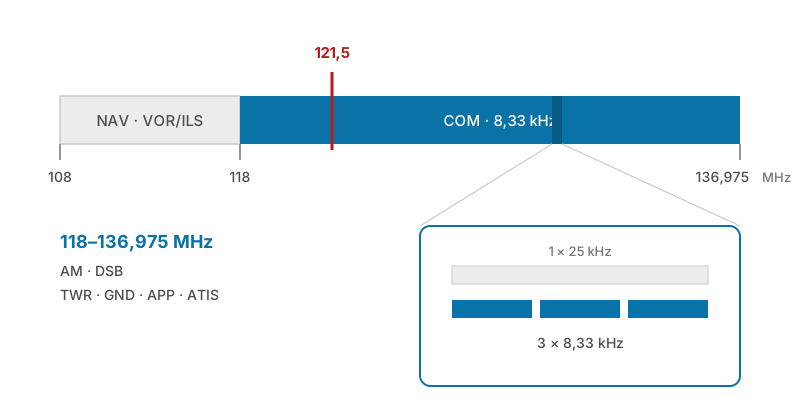
Frequencies are not divided into rigid blocks: every airport and every control unit receives its own assignments within the band. Some uses, however, come back again and again:
| Service | Who uses it | Frequencies |
|---|---|---|
| Control tower (TWR) | Take-offs, landings, the circuit | Assigned per airport, within 118–136.975 MHz |
| Approach (APP) | Arrival and departure sequencing | Assigned per control area |
| Ground movements (GND) | Taxiing, ground staff | Typically between 121.6 and 121.9 MHz |
| ATIS / VOLMET | Automated bulletins (weather, runway in use) | Assigned per airport or area |
| Emergency | Everyone | 121.5 MHz, continuously monitored |
| Air-to-air | Pilot-to-pilot communications | 123.45 MHz in oceanic and remote areas |
Range is the one typical of VHF, line of sight: at cruising altitude an aircraft talks to stations as far as 200 nautical miles away, while on the ground coverage depends on obstacles, as with any link in the VHF band.
Why aviation uses AM and 8.33 kHz channels
Unlike professional radios on the ground, which use frequency modulation, aeronautical communications use amplitude modulation (AM). This is not a historical leftover: with AM, if two stations transmit at the same time, the stronger signal does not completely cancel the other, and the controller can notice the overlap. A double advantage when dozens of aircraft share the same frequency.
Channels today are spaced 8.33 kHz apart: in Europe the old 25 kHz spacing has been split in three, tripling the channels available in a band that had become crowded. Apart from a few exceptions that remain at 25 kHz, such as the 121.5 MHz emergency channel, installed equipment has to be certified for 8.33 kHz spacing.
Who talks to whom: from the tower to ground staff
During a flight the pilot changes frequency several times: taxiing is coordinated on the ground movement frequency, take-off and landing with the control tower, the en-route phases with the area control units.
The airband, however, remains essentially reserved for communications with aircraft: pilots, control units and airline operational frequencies. Ground staff work on separate professional radio networks, typically TETRA or DMR: an airport therefore has two radio worlds living side by side, the VHF band for flight and the professional network for apron operations, among the parking stands and the taxiways.
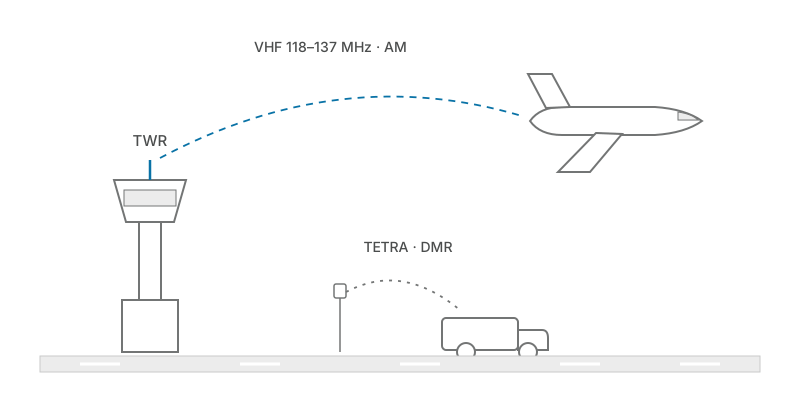
For anyone running an airport, the challenge is to guarantee coverage of both networks at every operational point, from the apron to the hangars, together with compliant recording of communications (the reference standard for recording over IP is ED-137). These are the themes of our solutions for aviation and airports: coverage of the aeronautical VHF band and of the TETRA and DMR networks on the ground, certified equipment, recording and maintenance from a single partner.
Emergency communications
121.5 MHz is the international aeronautical emergency frequency: it is monitored continuously by control units and many aircraft keep it tuned on their second radio. Alongside voice calls there are the transponder codes, which signal an emergency without a word being spoken:
| Signal | Meaning |
|---|---|
| Mayday | Grave and imminent danger, absolute priority |
| Pan-Pan | Urgent situation, but no immediate danger |
| Squawk 7700 | General emergency declared through the transponder |
| Squawk 7600 | Radio failure |
| Squawk 7500 | Unlawful interference on board |
Beyond VHF: HF and UHF
The VHF band works line of sight, so it is not enough over the oceans: intercontinental routes use HF frequencies (between 2.8 and 22 MHz), which propagate beyond the horizon. Military aviation uses a band of its own in UHF instead, between 225 and 400 MHz, with assignment rules separate from the civil ones: that is why searches so often turn up "military aviation frequencies" as a world apart.
Where to find up-to-date airport frequencies
Assignments change over time, and the lists circulating online age quickly. The official source is the AIP (Aeronautical Information Publication), which each country publishes through its own aviation authority: for every airport it lists the frequencies in use for tower, approach, ground movements and ATIS. For Italian airports the reference is the AIP Italia published by ENAV. For professional use it is the only reference to work from; any unofficial table should be checked against it before being taken at face value.
Frequently asked questions
Are aircraft radio frequencies AM or FM?
AM, amplitude modulation. The choice makes overlapping transmissions audible: if two stations talk at the same time the stronger signal prevails, but the overlap can still be heard, which is not the case in FM.
What is the emergency frequency in aviation?
121.5 MHz, monitored continuously by control units. In the military domain the UHF equivalent is 243 MHz. To these are added the transponder codes: 7700 for a general emergency, 7600 for radio failure, 7500 for unlawful interference.
Is it legal to listen to airband frequencies?
The rules differ from country to country. In Italy, simply listening is not expressly penalized, but the law prohibits disclosing or using the content of the communications, and transmitting on the airband without a license and certified equipment is unlawful. Professional use always requires type-approved equipment and the applicable authorizations.
Where can I find up-to-date airport frequencies?
In your country's AIP, the official aeronautical information publication: for every airport it lists the active frequencies for tower, approach, ground movements and ATIS. For Italian airports the reference is the AIP Italia published by ENAV; unofficial lists online age quickly and should always be checked against the official source.