
Solutions · PoC and PTT over broadband
We deliver turnkey PoC communications: terminals, SIMs, platform, and integration with the radio networks.
With PoC, professional push-to-talk travels over the LTE and 5G cellular network and over Wi-Fi: no radio infrastructure to build, no frequency licences, and the fleet is operational in days. We handle the whole supply: PoC terminals, multi-operator SIMs, the Respondr platform, and gateways to the existing TETRA and DMR networks, with every communication encrypted with TLS 1.3 and AES-256.

PTT over Cellular, or PoC, brings the push-to-talk of professional radios onto the LTE and 5G mobile network and onto Wi-Fi: press the button and you talk to the whole team, just as with a radio, but the link travels over the public network. There is no radio infrastructure to build and no frequency authorizations to obtain: a SIM takes the place of the licence, and activation is a matter of days, not months. Professional PoC adopts the application functions of the MCPTT standard, defined by 3GPP in Release 13 in 2016: groups with priorities, emergency call, and central management.
We handle the whole supply: portable and vehicle PoC radios with a physical PTT button, rugged smartphones with the Respondr app, including ATEX versions for hazardous areas, multi-operator SIMs (or we configure the ones you already have), the platform with its web and desktop consoles, and Bluetooth PTT accessories.
PoC works alongside mission-critical radio networks, it does not replace them. The TETRA or DMR network covers the operational sites; PoC brings vehicles on the road, remote sites, and staff without a radio back into the same talkgroups, wherever there is mobile coverage. Gateways and a unified console put radios and smartphones in the same group calls, and where the mobile network does not reach, a LEO satellite terminal carries the IP link. For the customer there is a single point of contact, from the terminals to the connectivity.

What to consider before adopting PoC.
PoC relies on public networks: the three points to settle during design so the fleet works as intended.
The channel depends on the public network
PoC follows the mobile operator’s coverage and traffic: in tunnels, on underground levels, and in areas with no service it does not work, unless a dedicated distribution system is in place. Where the channel has to be guaranteed at all times, a private radio network remains irreplaceable: that is why we propose PoC as a complement to PMR networks, not as a substitute.
Connecting sites with no mobile network
On remote construction sites, mountain sites, and at sea there is often no mobile network. A low-Earth-orbit (LEO) satellite terminal still provides the IP link, with a typical latency of 25–50 milliseconds: push-to-talk works with no perceptible delay. Geostationary satellites, at around 600 milliseconds round trip, should be avoided for PTT voice.
Making smartphones and radios talk together
The most frequent case is a TETRA or DMR network covering the operational sites and a PoC fleet that has to join the same talkgroups. The connection is made with gateways to the radio networks and with a unified console: the operator in the room talks to the radios and to the PoC terminals from the same interface.
How a PoC system integrated with the radio networks is built.
The terminals in the field connect over LTE, 5G, Wi-Fi, or satellite to the PTT platform, which routes the calls to the operator console and, through gateways, to the TETRA and DMR networks already in service.
- Terminals in the field
- The PoC radios with a physical PTT button and the smartphones running the Respondr app. Press the button and you talk to the whole team, on whatever network is available.
- Transport network
- The voice travels over an IP link: the LTE and 5G mobile network, local Wi-Fi, or a LEO satellite terminal where the mobile network does not reach.
- PTT platform
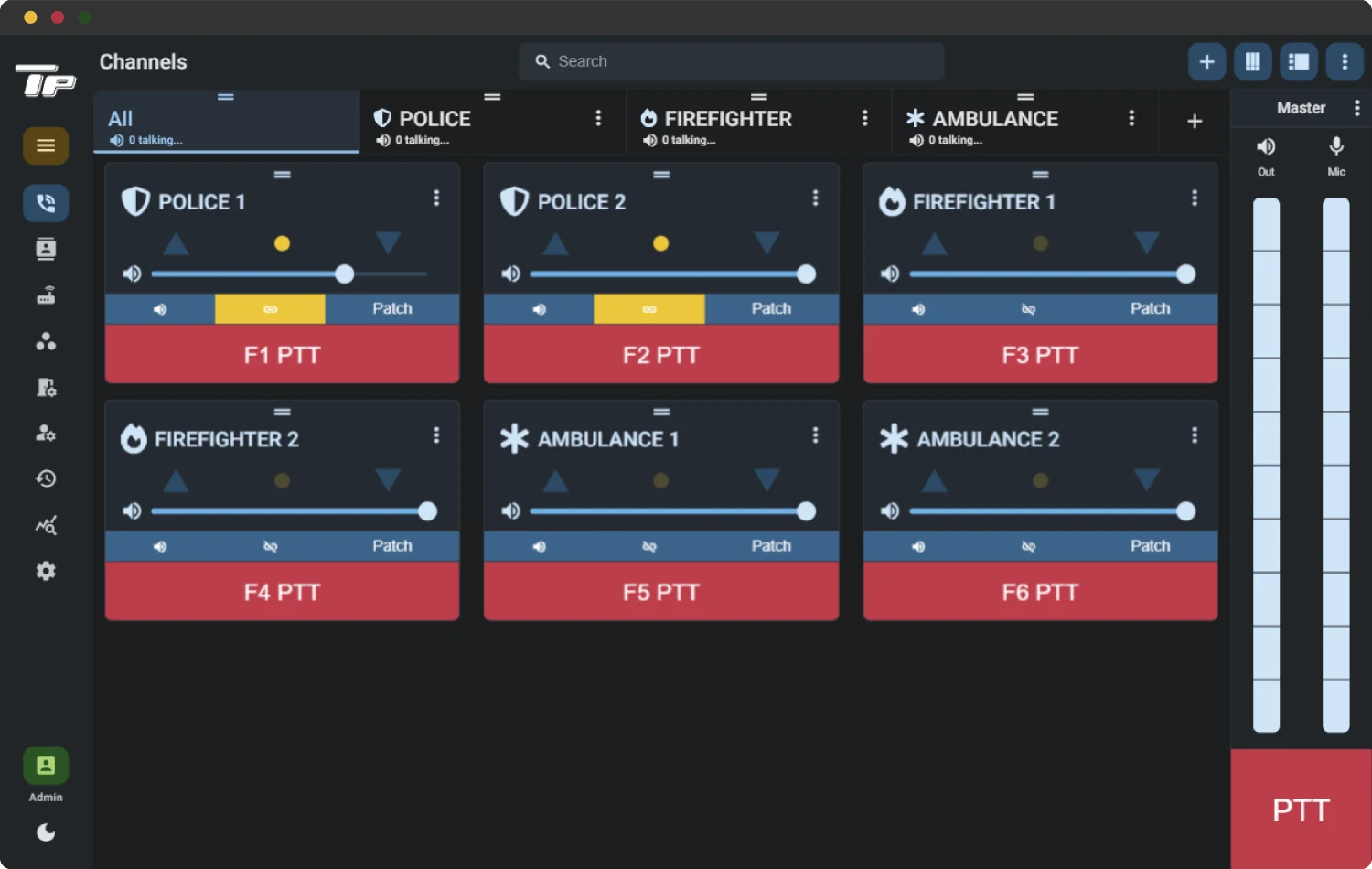
- It routes group and individual calls to the terminals and the operator console, and handles priorities, positions, and recording. In the cloud or in the customer’s control room.
- Connected radio networks
- The dashed line is the bridge through gateways to the TETRA and DMR networks already in service at the customer site: PMR radios and PoC terminals talk in the same talkgroups.
What a complete PoC supply includes.
The components we supply and the work we do to put the fleet into service, from the terminals to the operator console.
Terminals and accessories
- Portable and vehicle PoC radios with a physical PTT button, chosen for the working environment
- Rugged smartphones with the Respondr app, including ATEX versions for hazardous areas
- Brands we carry: RugGear, Telox, Inrico, and i.safe MOBILE
- Bluetooth PTT accessories: speaker microphones and external buttons, wired and wireless
- Delivery of the fleet already configured, with the groups and profiles loaded onto every terminal
Connectivity and SIMs
- Multi-operator SIMs supplied by Teleproject, or configuration of the SIMs the customer already uses
- Connection over LTE, 5G, and Wi-Fi, moving from one network to another without interrupting the communication
- A codec optimized for weak Wi-Fi, LTE on the move, and momentary loss of coverage
- LEO satellite terminals for sites with no mobile network, with a typical latency of 25–50 milliseconds
Platform and operator console
- The Respondr platform in the cloud or installed in the customer’s control room
- Android and iOS apps, a web console with corporate SSO, and a desktop client for Windows, Linux, and macOS
- Talkgroups, individual calls, priorities, and messages handled by the software
- GPS position of the terminals in real time on the console map
- Recording of the communications, searchable by radio ID, date, time, and channel
Integration with the radio networks
- Gateways to the TETRA and DMR networks already in service at the customer site
- Interfaces to analog VHF/UHF radios
- PMR radios and PoC terminals in the same talkgroups, on the same operator console
- Integration designed to suit your requirements, without replacing the networks that already work
Security and access control
- TLS 1.3 and AES-256 encryption on all voice and data traffic, including over public networks
- Role-based access control and integration with corporate SSO
- Traceability of every operator’s actions
- A platform compliant with the ISA/IEC 62443-3-3 Security Level 2 standard and with the NIS2 directive (EU 2022/2555)
Commissioning, training, and support
- Fleet configuration: terminal register, talkgroups, priorities, and user profiles
- Training for the control room operators and for the staff in the field
- Activation in days, with no radio infrastructure to build
- Support in service with a single point of contact for terminals, platform, and connectivity
Frequently asked questions.
The questions we are asked most often about this type of system.
What coverage do you need to use PoC?
You need an IP link, not necessarily a cellular one: the LTE or 5G mobile network, local Wi-Fi, or a LEO satellite terminal where the mobile network does not reach. PoC coverage is the operator’s coverage, so nationwide and, with roaming, across borders too. In tunnels and enclosed spaces, cellular coverage is brought in with a dedicated DAS; where there is no link at all, PMR radio networks remain the answer.
Does PoC replace TETRA and DMR radios?
No, it works alongside them. If the team covers a wide territory and the mobile network is there, PoC wins on coverage, simplicity, and cost; if the channel has to be guaranteed at all times — in tunnels, in an emergency, on critical infrastructure — a private radio network remains irreplaceable, because its channel does not depend on the traffic of a public network. In practice the right answer is often “both”: gateways and a unified console put radios and PoC terminals in the same talkgroups.
Do you supply the SIMs, or can I use my own?
Both routes are possible. Teleproject supplies multi-operator SIMs for the PoC terminals; alternatively the customer can use its own SIMs, which our technicians configure together with the rest of the fleet. Either way we deliver the terminals already configured, with the groups and profiles loaded.
Are there PoC terminals for explosion-risk areas?
Yes. The catalog includes smartphones and terminals in ATEX versions for classified areas, such as those from i.safe MOBILE. For Iren we handled the supply of ATEX certified PoC devices.
How long does it take to put a PoC fleet into service?
Days, not months. There is no radio infrastructure to build and no frequency authorizations to apply for: the terminals, the SIMs, and the platform are enough. Our technicians configure the fleet, the groups, and the profiles and train the operators, so the PoC network enters service ready to use.
Are PoC communications secure?
That depends on the platform that handles them, not on the individual terminal. With Respondr, all voice and data communications are encrypted with TLS 1.3 and AES-256, including over public networks; the platform complies with the ISA/IEC 62443-3-3 Security Level 2 standard and with the NIS2 directive (EU 2022/2555), with role-based access control and traceability of every operator’s actions.
Request a proposal for PoC and PTT communications over broadband.
For every project we provide a tailored technical and commercial proposal based on your requirements — feasibility analysis, RF coverage study, and intervention planning.