

Integrating a PBX with a radio network
Connecting a PBX (Private Branch Exchange) to a professional radio network — DMR, TETRA, VHF — lets radio users call telephone extensions directly, and vice versa. The integration requires dedicated gateways that translate audio streams and control signals between the two systems.
Radio technologies involved
The main radio technologies that integrate with telephone systems:
- DMR (Digital Mobile Radio) — operates on 12.5 kHz channels with 4FSK modulation and two-slot TDMA. Voice codec: AMBE+2.
- TETRA — trunked system with four TDMA slots per channel, built-in encryption, and fast call setup. Codec: ACELP.
- VHF/UHF (PMR) — conventional analog or digital networks on the 136–174 MHz (VHF) and 403–470 MHz (UHF) bands.
- LMR / PMR — the foundation of licensed professional radio communications.
Telephone gateways
The gateway is the device that bridges the radio network and the telephone system. It converts audio and synchronizes control signals between the two systems.
How the DMR gateway works
The gateway receives voice traffic from the DMR controller as AMBE+2 packets and converts them to the PBX audio format — typically G.711 for analog lines or SIP/G.711 for VoIP systems. Each active PBX voice path requires a dedicated gateway.
Phone-to-radio flow:
- The telephone user dials a dedicated line number.
- They enter the individual or group radio number.
- The DMR controller receives the string and applies the
in-phonetable rules to find a match. - It replaces the dialed digits with the resulting radio number and sets up the DMR call.
Radio-to-phone flow:
- The radio user dials a number string.
- The controller applies the
out-phonetable rules. - It replaces the string with the telephone number and routes the call to the appropriate FXO group.
4-Wire E&M interface
The 4-Wire E&M (Ear & Mouth) interface is the established standard for interconnecting with analog telephone exchanges. It uses four wires for bidirectional audio — two for TX and two for RX — plus E&M control signals. The physical separation of the audio paths minimizes interference and delivers audio quality with latency below 100 ms.
VoIP gateways for DMR and TETRA
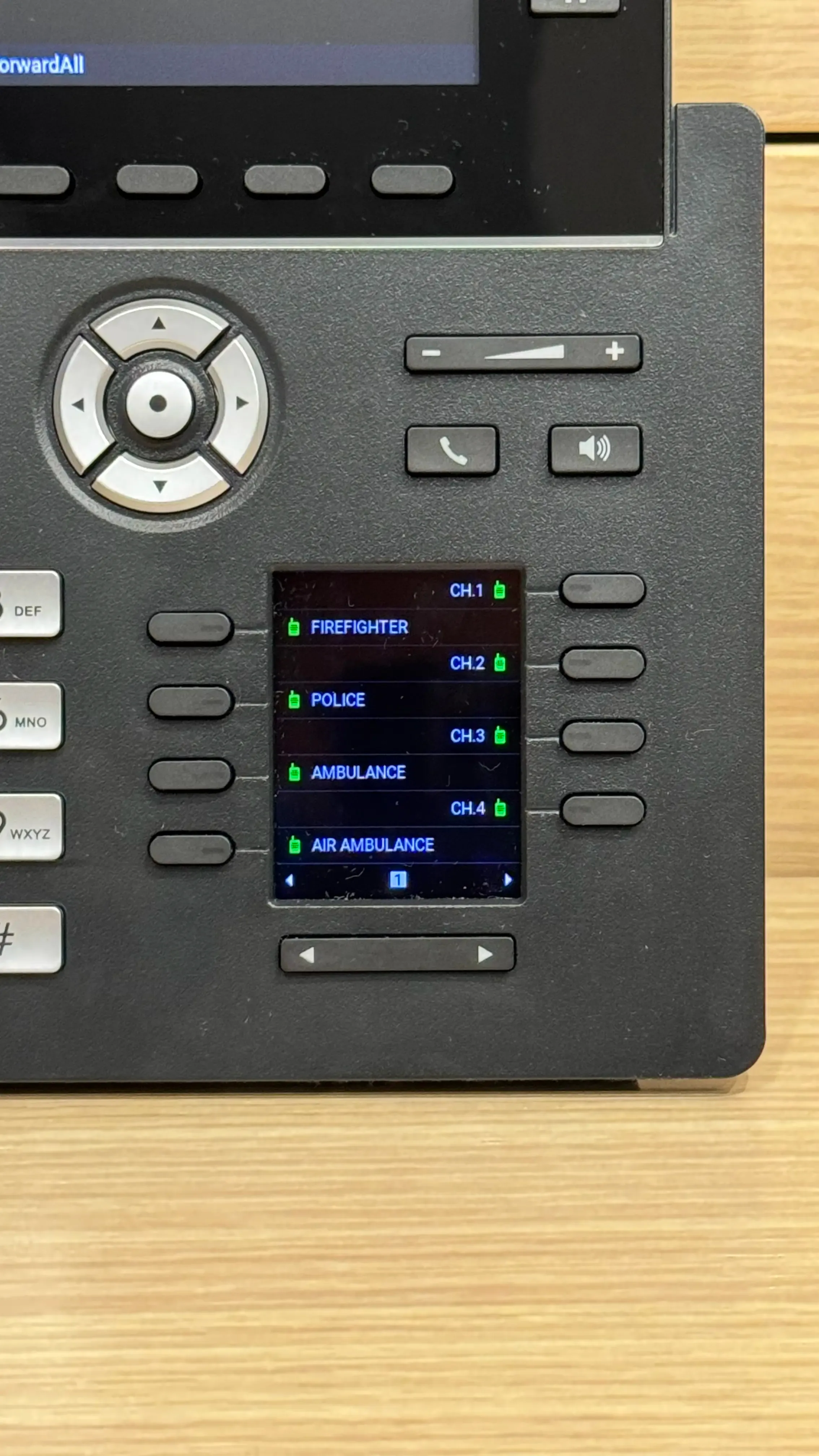
As IP networks have become the norm, VoIP-based integration has become the most flexible approach. VoIP gateways for DMR and TETRA handle:
- Advanced transcoding between radio codecs (AMBE+2 for DMR, ACELP for TETRA) and standard VoIP codecs (G.711, G.729).
- Compatibility with IP-PBX systems and VoIP platforms, reusing existing network infrastructure.
- Additional capabilities such as call recording, audio conferencing between radio and telephone users, and advanced call management.
- Scalability by expanding channel count or adding features without replacing hardware.
Design considerations
For a correct integration, evaluate:
- Simultaneous channels required — determines the gateway capacity needed to handle multiple concurrent calls.
- Supported voice codecs — ensures compatibility between systems and consistent audio quality.
- Latency requirements — important for communications without perceptible delay, especially for PTT.
- Redundancy — increases reliability in the event of failures on critical components.
- Available bandwidth — the IP network must support the additional traffic without degrading performance.
Frequently asked questions
How is voice quality managed?
Through dedicated codecs and transcoding systems that maintain a high signal quality between the two systems. Overall latency depends on the quality of the IP network and the codec in use.
Is encrypted communication possible?
Yes. Both DMR and TETRA support encryption. VoIP gateways can handle encryption across the entire path, securing communications over the IP segment as well.
Is it possible to integrate analog and digital radio networks?
Yes. Analog networks typically use the 4-Wire E&M interface, while DMR and TETRA digital networks require dedicated VoIP gateways with AMBE+2 or ACELP transcoding.
How is PTT handled in the integration?
PTT is synchronized through control signals in both the 4-Wire E&M interface and VoIP gateways, using specific protocols to coordinate communications between radio and telephone systems.