

Monitoring cellular networks and DAS systems
In highway tunnels, large buildings, and critical infrastructure, cellular signal quality cannot be taken for granted. Network operators, passive infrastructure managers, and highway concessionaires need continuous visibility: knowing in real time whether a sector has lost coverage or whether performance is degrading before the end user notices.
From GSM to 5G: comparing generations
The cellular network has gone through five generations, each with specific monitoring parameters.
2G GSM operates on the 900 MHz and 1800 MHz bands and provides voice and basic data transmission (GPRS/EDGE). Despite being a mature technology, it remains present in many areas and is still the fallback for emergency calls at remote sites.
3G UMTS networks typically operate on the 900 MHz and 2100 MHz bands and introduce significantly higher data speeds (HSDPA/HSUPA). Monitoring requires verification of WCDMA parameters and handover management between cells.
4G LTE can reach 150 Mbps on the downlink and operates across multiple bands (B1, B3, B7, B8, B20, B28A). The reference parameters are RSRP, RSRQ, and SINR, which describe the power and quality of the radio link with greater precision than RSSI alone.
5G DSS (Dynamic Spectrum Sharing) allows 4G and 5G to coexist on the same band: it requires monitoring systems capable of distinguishing between the two technologies and analyzing dynamic spectrum allocation.
Parameters to monitor
| Parameter | Technology | What it indicates |
|---|---|---|
| RSSI | 2G / 3G / 4G | Received signal power |
| RSRP | 4G LTE | LTE reference signal received power |
| RSRQ | 4G LTE | LTE reference signal received quality |
| SINR | 4G / 5G | Signal-to-interference-plus-noise ratio |
| Latency / jitter | 4G / 5G | Performance for real-time critical applications |
What is a DAS system
A Distributed Antenna System (DAS) is an infrastructure that distributes cellular coverage inside buildings, tunnels, or specific areas through a network of antennas or radiating cables connected to a common source. It provides uniform coverage where the external signal cannot penetrate.
Passive DAS distributes the signal using splitters and couplers, without amplification. Active DAS regenerates the signal with amplifiers at remote units, covering longer distances and larger structures.
Why monitor a DAS system
A malfunctioning DAS can create dead zones, inter-sector interference, or performance degradation affecting thousands of users simultaneously. In highway tunnels, loss of signal can compromise traveler safety and the response of emergency services; in hospitals and large facilities, the operational and financial consequences can be significant.
Proactive monitoring allows you to identify degradation and impending failures before they translate into service disruptions. Analysis of historical trends supports planning for preventive maintenance.
Continuous monitoring or periodic measurements?
Traditionally, cellular network control relied on periodic drive tests: technicians with portable instruments mapped coverage at a given moment. This approach does not detect intermittent problems and leaves the hours between surveys uncovered.
Fixed, automated monitoring systems solve both issues: they operate 24/7, detect anomalies as they occur, and generate immediate alerts. Multi-technology (2G, 3G, 4G, 5G) and multi-operator coverage on a single device simplifies the architecture and reduces operating costs.
TP-CELLX: monitoring cellular networks and DAS systems
TP-CELLX is the Teleproject solution for continuous outdoor monitoring of cellular networks. Rated IP67, it operates without interruption in any environmental condition — from the humidity of tunnels to the thermal cycling of outdoor installations.
The integrated cellular module monitors 2G, 3G, and 4G LTE networks from any operator, eliminating the need for separate devices per technology. The 4G bands B1, B3, B7, B8, B20, and B28A cover the full spectrum of European operators; for 3G, bands B1, B3, and B8; for 2G, bands B3 and B8. 5G DSS monitoring is available in the TP-CELLX Pro variant.
Real-time interface
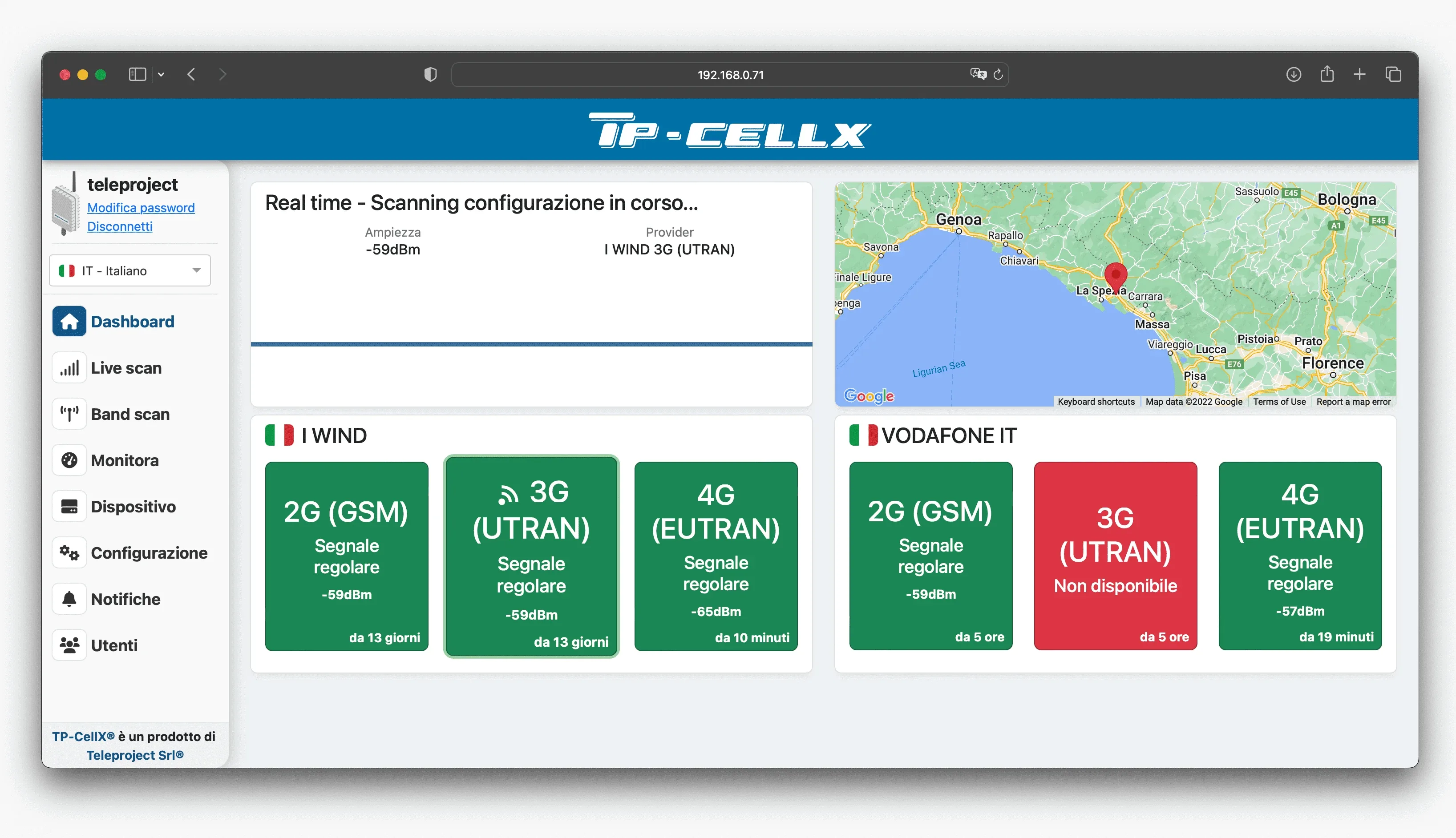
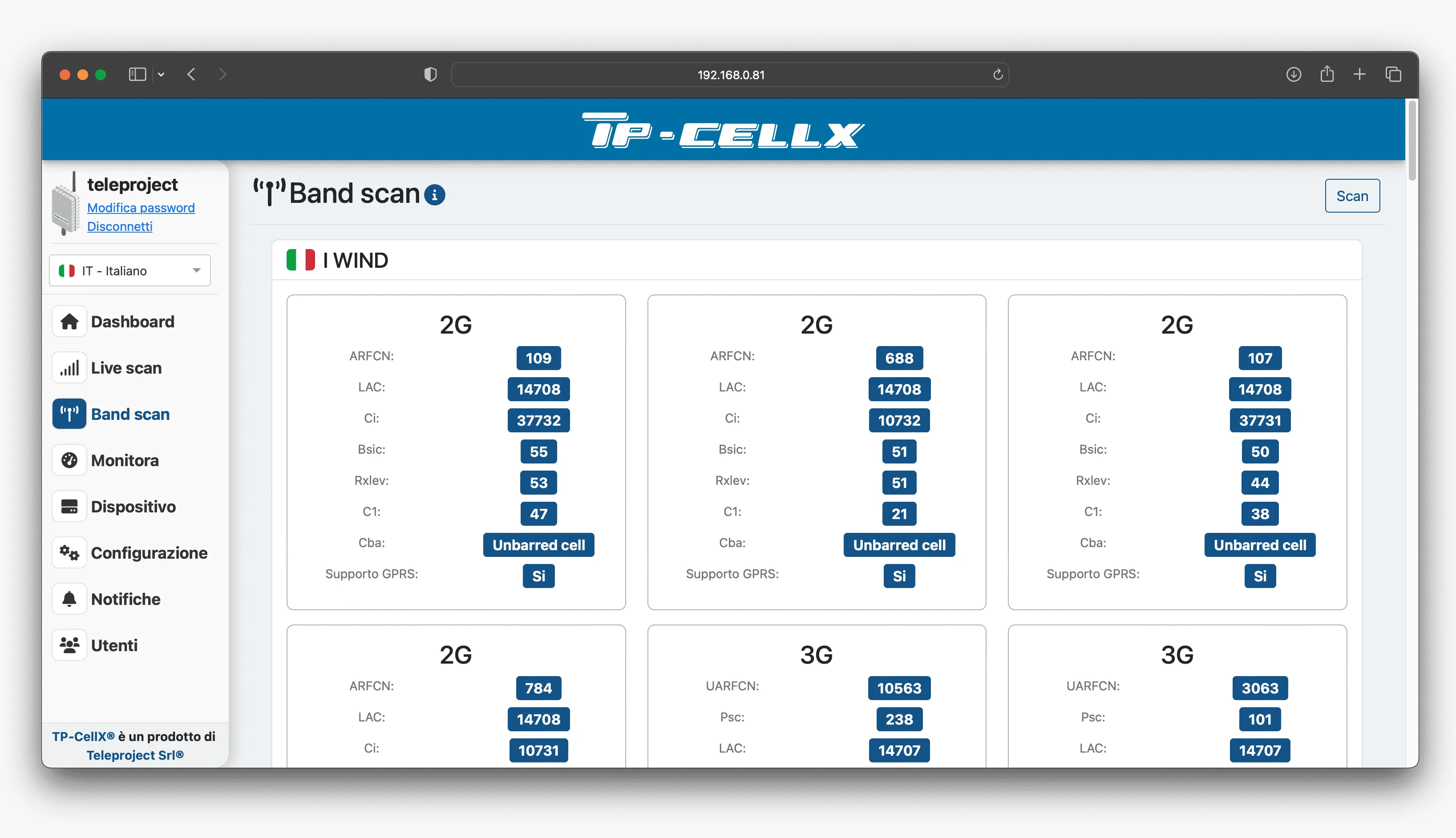
The web interface displays the status of each operator and technology in real time. The band scan shows all cells in the coverage area with signal level, quality, and network parameters for each — useful for identifying interference, new installations, or changes in network configuration.
History and trend analysis
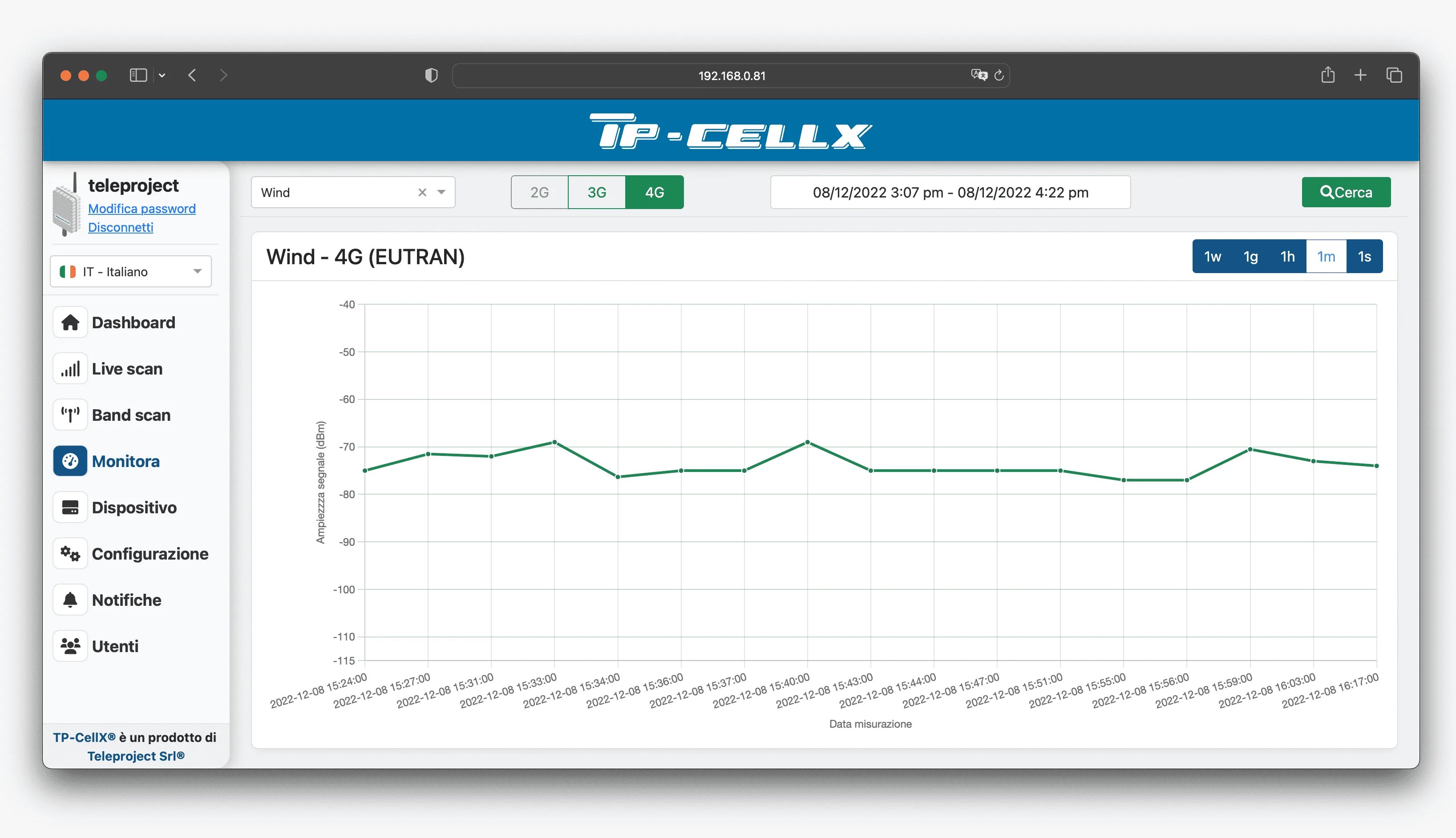
The history page lets you navigate back in time and analyze how signal quality evolves. Correlating degradation with external factors — weather conditions, infrastructure works, events — helps identify root causes and plan interventions.
Notifications and integration
The multi-channel notification system sends alerts via email and SNMP v2c. PoE power — a single Ethernet cable for both power and data — simplifies installation even at the most remote points in tunnels. SNMP support facilitates integration with existing NMS platforms, allowing you to correlate cellular events with other infrastructure metrics.
Case study: cellular monitoring in a highway tunnel
A highway management company installed 10 TP-CELLX units to monitor cellular coverage in tunnels along a strategic highway section. The tunnels — environments with high humidity, significant temperature variations, and dust — represent one of the most critical scenarios for mobile communications.
The units were positioned at the entry/exit transition zones, where handover problems typically concentrate. Multi-operator monitoring revealed significant differences in quality of service between carriers, allowing the highway operator to agree on targeted interventions with the affected operators.
The availability of historical data optimized maintenance interventions, reducing the cost of emergency inspections. The automated alarm system reduced fault identification and resolution times.
Frequently asked questions
What is the difference between RSSI and RSRP in LTE monitoring?
RSSI measures the total received power on the band, including interference and noise. RSRP measures only the power of the LTE reference signals: it is more accurate for assessing the real quality of the radio link in 4G networks.
Does TP-CELLX also monitor 5G networks?
5G DSS (Dynamic Spectrum Sharing) is supported by the TP-CELLX Pro variant — the dedicated model for 5G DSS and 5G NR monitoring. The standard TP-CELLX covers 2G, 3G, and 4G LTE from any operator.
Is a separate device needed for each operator?
No. TP-CELLX monitors multiple operators and technologies (2G, 3G, 4G) with a single device, eliminating the need for separate hardware per carrier.
How does it integrate with existing supervisory systems?
Via SNMP v2c: TP-CELLX alerts flow into NMS platforms already in use — such as Track-TP — allowing you to correlate cellular events with other infrastructure metrics.