
Radio technologies
PTT over Cellular: professional radio over the cellular network.
PTT over Cellular, or PoC, brings professional-radio push-to-talk to the LTE and 5G cellular network and to Wi-Fi: press the button and talk to the whole team, with nationwide coverage and no radio network to build. We explain what it is, how it works, when it beats PMR radios, and how it integrates with existing TETRA and DMR networks.

What PTT over Cellular is
PTT over Cellular, often shortened to PoC, is professional-radio push-to-talk carried over the cellular network. Press the button and talk to the whole team, exactly as with a radio, but the connection travels over the LTE or 5G mobile network, or over Wi-Fi, instead of over your own radio frequencies.
The practical upshot is twofold. There is no radio infrastructure to build: no repeaters, no towers, no frequency paperwork. And the coverage is the mobile network’s, so nationwide, and across borders where roaming is available. In place of a license there is a SIM; in place of a network design, a per-terminal fee. And activation is a matter of days, not months.
Terminals come in two kinds: an app on a smartphone, including the ones you already have, or a dedicated PoC radio, with a physical PTT button and the ruggedness of a professional radio. Teleproject supplies both, plus the platform that manages them. It is the approach behind our PoC and PTT communications over broadband, complementary to the TETRA and DMR radio networks.
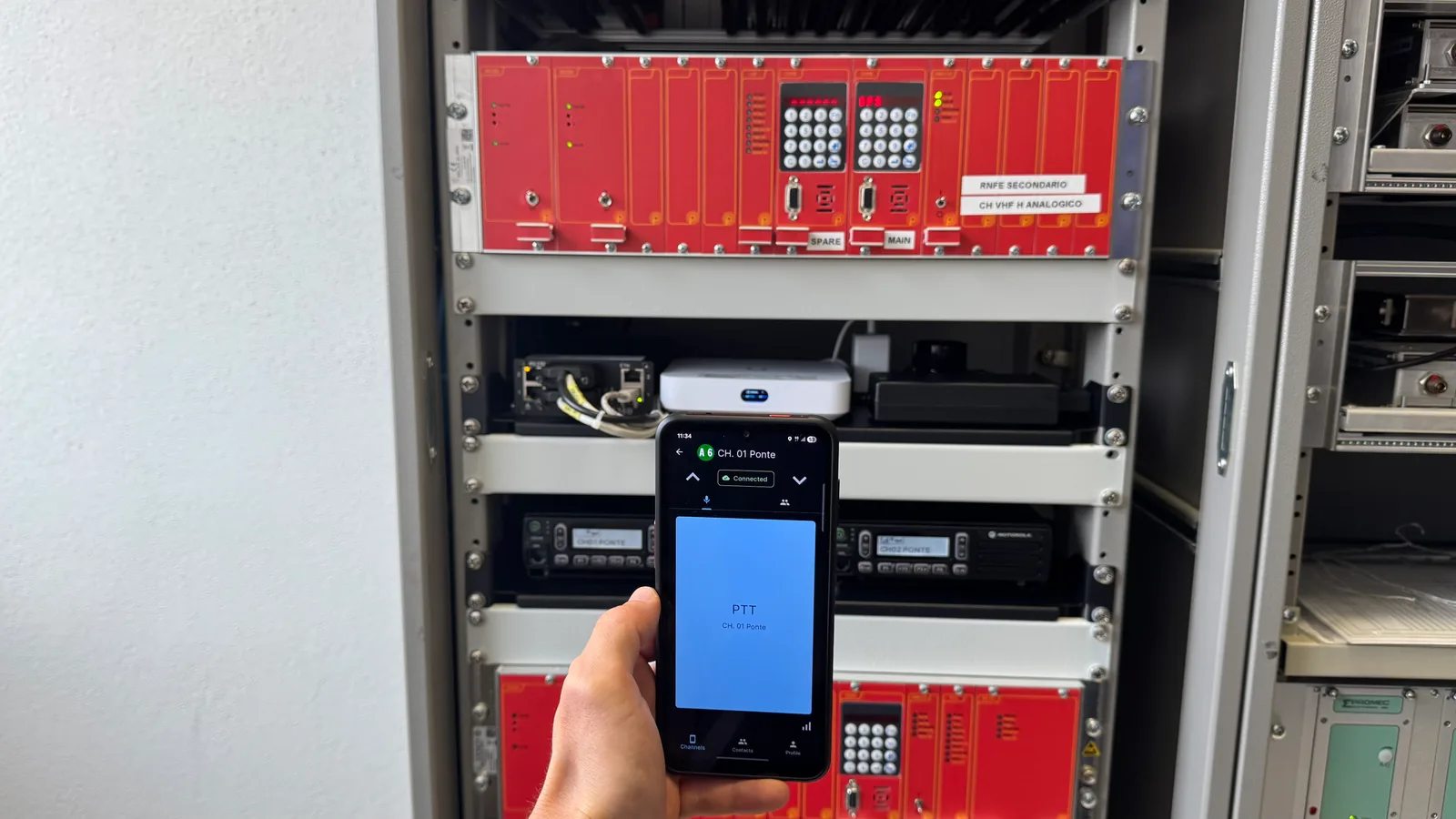
How PoC works
The chain is simple: from the terminal to the console, the voice travels over the public network and through a software platform that does what the infrastructure does in a radio network.
A smartphone app or a dedicated PoC radio connects to the cellular network or to Wi-Fi; the network carries the voice to a PTT platform, in the cloud or installed in the control room; the platform routes it to the other terminals in the group and to the operator console. Groups, individual calls, priority, GPS position, messaging, and recording are handled by the software: the terminal can switch from LTE to 5G to Wi-Fi without interrupting the communication.
- Terminals and network
- Dedicated PoC radios or a smartphone app: the voice travels over any IP connection, LTE/5G cellular network or Wi-Fi, and the terminal switches from one network to another without interrupting the service.
- Platform and console
- The PTT platform, in the cloud or on-premise, manages groups, priorities, GPS positions, messaging, and recording; the operator follows everything from the console in the control room.
MCPTT: the mission-critical PTT standard
Not all PoC is the same. MCPTT, short for Mission Critical Push To Talk, is the standard defined by 3GPP, the body that standardizes mobile networks, introduced with Release 13 in 2016. It adds to cellular push-to-talk the functions that critical communications need: dedicated quality-of-service classes on the operator network, with priority for voice; pre-emption of ordinary traffic during congestion; the emergency call; and a direct terminal-to-terminal mode that works even without a network. Later versions of the standard extended the model to critical data and video.
Full MCPTT requires support from the mobile operator, which is not always available on commercial networks. Professional PoC platforms adopt its application-level functions anyway, priority groups, emergency calling, and centralized management, which cover most operational needs.
PoC or PMR radio: which to choose
PoC does not replace professional radio: it works alongside it. The table sums up the differences; the choice depends on the terrain and on operational requirements.
| PoC | PMR radio | |
|---|---|---|
| Coverage | Nationwide, wherever the mobile network reaches | Local, around the private-network sites |
| Licensing | No frequencies of your own, just the SIM | Authorization and frequency usage rights |
| Costs | Per-terminal fee, no network to build | High up-front investment, then low costs |
| Channel | Depends on the operator public network | Private and guaranteed, even in an emergency |
| Commissioning | Days | A project: survey, authorizations, installation |
- Private PMR network
- Covers the area around its own radio sites, with a private channel guaranteed even in an emergency: it is the choice when operations focus on defined sites and routes.
- PTT over Cellular
- Covers the whole territory served by the mobile network, with no infrastructure to build: it is the choice when teams move across large areas, with the limitation of areas without signal.
The criterion is simple. If the team works across a wide area and the mobile network is there, PoC wins on coverage, simplicity, and cost. If the channel must always be guaranteed, in a tunnel, in an emergency, on critical infrastructure, the private radio network stays irreplaceable: its channel does not depend on the traffic of a public network. That is why, in practice, the right answer is often “both”.
Explore the two radio technologies in the TETRA guide and the DMR guide, and see how to run them together with PoC in the next section.
Better together: PoC that extends the radio network
The real advantage of PoC is not to replace radio, but to complete it where radio does not reach. This is where the two technologies become a single network.
The scenario is an everyday one: the TETRA or DMR network covers the operational sites, but vehicles on the move, remote locations, and staff without a radio stay outside it. PoC brings them back into the same groups, wherever there is a mobile network. A gateway and a unified console put radios and smartphones in the same group calls, and the operator in the control room sees everything from a single interface.
- The two networks stay what they are
- The private radio network keeps its guaranteed channel; PoC carries the voice where the radio network does not reach, to vehicles on the move, to remote locations, and to staff without a radio.
- The console unites them
- A gateway and a unified console put radios and smartphones in the same call groups: the operator in the control room follows everything from a single interface, in this case Respondr.
Respondr unifies radio and PoC in a single console
Respondr is the dispatch platform developed by Teleproject: it unifies TETRA, DMR, analog radios, and PTT over Cellular in a single operator console, with Android and iOS apps, web and desktop consoles, and TLS 1.3 / AES-256 encryption. It is how we get radios and smartphones talking in the same groups.
PoC without a cellular network: the satellite link
PoC needs an IP connection, not necessarily a cellular one. Where the mobile network does not reach, the satellite provides it.
On remote worksites, on mountain sites, in emergency and civil-protection scenarios, or at sea, the mobile network is often absent. A low-orbit satellite terminal, a LEO such as Starlink, provides connectivity anyway: a satellite terminal, a local router or Wi-Fi, a PoC radio, and the team talks to the control room just as from anywhere else.
The type of satellite matters. LEO terminals have a typical latency of around 25–50 milliseconds, well within the limits recommended for voice, so push-to-talk works with no perceptible delay. Geostationary satellites, with around 600 milliseconds round-trip, introduce a delay that is noticeable and degrades the conversation: they should be avoided for PoC voice.
Teleproject’s role is to design the hybrid connectivity, satellite, cellular, and Wi-Fi, and integrate it into the communication system, with a single point of contact for the radio side, the IP side, and the field teams. System integration.

- You need an IP connection, not the mobile network
- Where cellular coverage does not reach, a LEO satellite terminal such as Starlink brings connectivity: the PoC radio connects to the local router and the team talks to the control room just as from anywhere else.
- LEO latency holds up for voice
- Low-orbit terminals have a latency of around 25–50 ms, adequate for push-to-talk; geostationary satellites, with around 600 ms, introduce a delay that is noticeable and should be avoided for voice.
Where PoC is used
Wherever you need coordinated teams across a wide area, without the time or the budget to build a dedicated radio network.
Transport and logistics
Fleets and couriers over a national area, vehicles on the move and depots connected to the same control room.
Private security and events
Patrols, guard duties, and public events: teams that change every day, immediate citywide coverage with no network to install.
Field maintenance and utilities
Teams spread across extended networks and plants, in constant contact with the control center wherever there is a mobile network.
Healthcare
A link between sites, vehicles, and staff in the field, with groups and priorities managed from the control center.
Hospitality and facilities
Hotels, shopping centers, and campuses: internal staff coordination over Wi-Fi and LTE.
Construction and major works
Temporary worksites spread across the territory: teams and vehicles operational right away, with no dedicated radio network to lay.
What Teleproject offers for PoC
From the platform to the terminals, from integration with existing radios to connectivity: we handle the PoC network with a single point of contact.
Respondr, the platform
Our dispatch and PTT platform: Android and iOS apps, web and desktop consoles, TLS 1.3 / AES-256 encryption, in the cloud or in your control room. It manages groups, priorities, positions, and communication recording.
PoC terminals
Rugged PoC radios and rugged smartphones, including ATEX versions for hazardous areas, with Bluetooth PTT accessories: speaker microphones and external buttons. Brands we carry: RugGear, Telox, Inrico, and i.safe MOBILE.
Hybrid networks and integration
Gateways to TETRA and DMR networks, a unified console, and integration design: we get radios and smartphones talking in the same groups, without replacing what already works.
Connectivity and rollout
We supply multi-operator SIMs for the terminals, or we use yours; we configure the fleet, the groups, and the profiles, and we train the operators. The PoC network goes live ready to use.
Frequently asked questions about PTT over Cellular
Licensing, coverage, security, and integration with radios: the essential answers to the questions we get most often about PoC.
Do you need a license to use PoC?
No. PoC uses the public LTE and 5G networks, whose frequencies are already licensed to the mobile operators. You need no authorization and no usage rights for your own frequencies: the SIM contract is enough. This is the main difference from a PMR radio network, which instead requires authorization on its own frequencies.
Does PoC work without cellular coverage?
You still need an IP connection: it can be the local Wi-Fi or a LEO satellite terminal such as Starlink, which brings connectivity where the mobile network does not reach. Where there is no connection at all, or where the channel must be guaranteed, PMR radio networks remain the answer; in a tunnel, cellular coverage is brought in with a DAS.
What is the difference between PoC and MCPTT?
PoC is push-to-talk over the cellular network in general. MCPTT is the 3GPP standard, introduced with Release 13 in 2016, that makes it mission-critical: guaranteed priority and quality of service on the operator network, pre-emption of ordinary traffic, and the emergency call. Professional PoC adopts its application-level functions.
Do PoC radios talk to TETRA and DMR radios?
Yes, through a dispatch platform. A gateway and a unified console put radios and smartphones in the same call groups: an operator on a TETRA or DMR network and a team on PoC hear each other as if they were on the same network. That is what Respondr does.
What devices do you need for PoC?
An app on a smartphone, including the ones you already have, or a dedicated PoC radio: the same physical PTT button and the same ruggedness as a professional radio, but with a SIM in place of the license. Bluetooth accessories such as speaker microphones let you talk without taking out the terminal.
Are PoC communications secure?
It depends on the platform. With Respondr, communications are encrypted with TLS 1.3 and AES-256 on every channel, the same level of security specified for mission-critical communications. The real security of PoC is that of the platform that manages it, not of the individual terminal.
Let’s talk about your PoC project.
A fleet to coordinate, a radio network to extend, or a new team to connect: we help you choose terminals and platform, and we handle configuration, connectivity, and support.