
Radio technologies
VHF and UHF radio: the bands of professional radio communications.
VHF and UHF are the frequency bands that professional radios work on, from business fleets to aviation and marine services. We explain the difference between the two bands, how a network with a repeater works, when to choose analog or digital, and what Teleproject builds: from network design to dispatching.

What the VHF and UHF bands are
VHF, short for Very High Frequency, and UHF, Ultra High Frequency, are two portions of the radio spectrum: the VHF band runs from 30 to 300 MHz, the UHF band from 300 MHz to 3 GHz. In practice, professional radios work on much narrower portions: the equipment typically covers 136–174 MHz in VHF and 400–470 MHz in UHF, and each country assigns frequencies to the professional mobile radio service within those portions.
Unlike TETRA and DMR, "VHF/UHF" does not name a standard: it names the spectrum. Analog and digital radios work on the same frequencies, and the special services live inside the same bands: the airband, marine VHF, and license-free PMR446. This guide explains the bands; the digital standard is covered in the guide to DMR technology.
Teleproject designs and builds mission-critical radio networks in the VHF and UHF bands, analog, digital, and mixed, from licensing to commissioning.

VHF or UHF: which to choose
The practical difference between the two bands is propagation: how the radio wave behaves across the terrain.
At the same power, VHF reaches farther in open country: the longer wave loses less energy over distance. UHF penetrates better into buildings and urban areas: the shorter wave slips between obstacles and passes more easily through doors, windows, and structures. Antennas matter too, shorter and more manageable in UHF, along with background noise, generally higher in VHF because of electrical interference.
- VHF · 136–174 MHz
- The longer wave loses less energy over distance: at the same power it reaches farther in open country, in the countryside, and in the mountains.
- UHF · 400–470 MHz
- The shorter wave slips more easily between obstacles: it performs better in cities, buildings, warehouses, and enclosed spaces.
These differences drive the selection criteria: in the countryside, in the mountains, and on out-of-town routes, VHF is the better choice; in cities, indoors, in warehouses, and on construction sites, UHF is the better choice. In tunnels and complex buildings the band alone is not enough: the signal is carried where it is needed with DAS and radiating cable.
There is no "best" band: there is the right band for the area to be covered. The real choice comes from a radio coverage study, not from a catalog.
How a VHF/UHF radio network works
Three concepts are enough to understand any radio project in these bands: simplex, the repeater, and multi-site coverage.
Radio to radio: simplex
In the simplest configuration, the radios communicate directly with each other on the same frequency, with no infrastructure. Range is limited by obstacles and terrain: on the ground you cover a few kilometers. It is fine for teams working close together: a construction site, a yard, an event.
The repeater
To cover a wider area, a repeater is installed in a commanding position, on a mast or a hilltop: it receives the signal on one frequency and retransmits it on another. Coverage goes from local to wide-area, and the radios communicate even when they cannot see each other directly. In everyday speech "ponte radio" refers to the repeater itself; microwave radio links are something else: point-to-point links that interconnect the sites.
- Simplex, radio to radio
- The radios communicate directly on the same frequency, with no infrastructure: fine for teams working close together, with range limited by obstacles and terrain.
- Repeater
- From a commanding position it receives on one frequency and retransmits on another: coverage goes from local to wide-area, across a valley, a city, or a route.
Coverage and sites
Large areas are covered with multiple repeaters, interconnected over microwave links or an IP network. On long routes the most efficient solution is the simulcast (same-frequency) network, explained in the guide to DMR technology. Coverage is not improvised: it is designed with a radio coverage study and verified in the field with RF measurements and drive tests.
Analog or digital
Analog and digital networks coexist on the VHF and UHF bands. The choice depends on the fleet, the services, and the budget.
Analog is still enough in many cases: a small fleet, a contained area, voice only. It is simple, rugged, and interoperable across different manufacturers, and it remains fully legal and supported. Digital DMR is worthwhile when you need more capacity on the same license, two communications per channel thanks to the 2 TDMA slots, steady audio right up to the edge of coverage, messaging, GPS location, and safety functions such as man-down.
Migration is not a leap: DMR equipment also works in analog, so you migrate in stages, first the radios and then the channels, without stopping service. Teleproject designs and maintains analog, digital, and mixed networks. To dig deeper, read the guide to DMR technology and the article Moving from analog PMR networks to digital DMR.
The special bands: airband, marine, and PMR446
Inside the VHF and UHF bands live services with their own rules and equipment. Three of them come up most often in our projects.
A schematic representation, not to scale. Professional radios typically work in VHF 136–174 MHz and UHF 400–470 MHz; the special services live inside the same bands: airband in amplitude modulation, marine, and license-free PMR446.
VHF airband: 118–137 MHz in AM
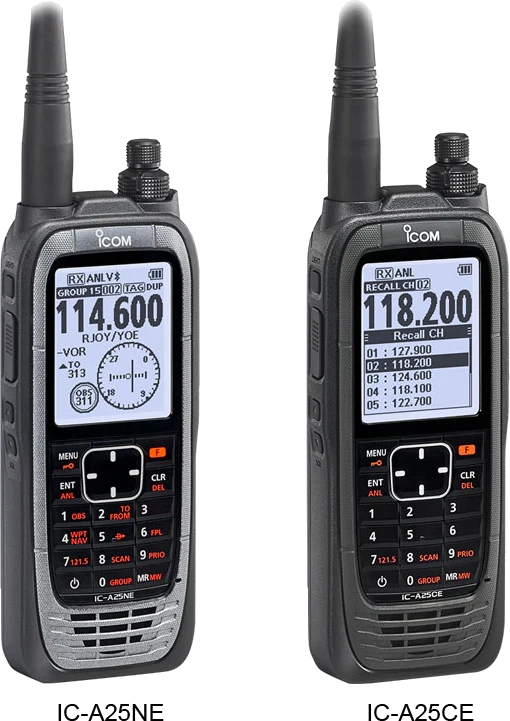
This is the band for communications between pilots and ground stations, in amplitude modulation and with 8.33 kHz channel spacing in European airspace. Teleproject designs and installs airband communication systems for airports and airfields and integrates them into control rooms: Respondr supports the aviation VHF protocol alongside professional radio networks. Airband systems.

Marine VHF: 156–162 MHz
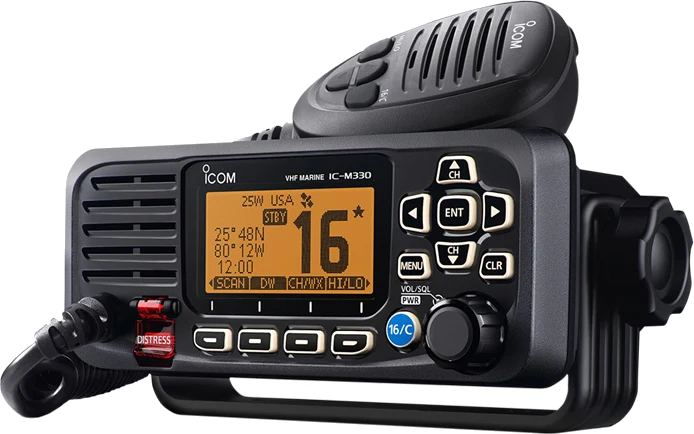
This is the band for communications at sea, with channel 16 reserved for calling and distress. We supply and install fixed and portable units for port and coastal use, which can be integrated into professional radio networks and dispatching platforms. Marine equipment and marine VHF. To dig deeper: Marine VHF radios: frequencies, coverage, and use.

PMR446: the license-free band
PMR446 radios use the 446.0–446.2 MHz band, harmonized across Europe and license-free: power limited to 500 mW, an integrated antenna, and no repeater. They are fine for personal use and small businesses, but they do not replace a professional radio network. For frequencies, power levels, and limits: PMR446 explained: use, frequencies, power, and DMR Tier I.

Where VHF/UHF radios are used
From airport runways to ports, from highway routes to industrial sites: each sector has its own dedicated page.
Aviation and airports
Airband systems for coordinating vehicles and ground teams.
Marine and maritime
Marine VHF units for ports, coast, and professional operators at sea.
Highways and tunnels
Analog and mixed radio networks along the route, with coverage in the tunnel bores via radiating cable.
Utilities and industry
Operational fleets across large sites, with simple analog networks or gradual migration to DMR.
Transport and logistics
Fleet communications for depots, terminals, and vehicles moving across large areas.
Mines and quarries
Reliable communications underground and at extraction sites, including hazardous environments.
What Teleproject offers for VHF/UHF
A radio network is not an off-the-shelf product: it is a project. We handle the entire cycle, from licensing to maintenance, with products developed in-house for monitoring.
Complete radio networks, including analog and mixed
We handle the project with a single point of contact: coverage study, licensing, equipment supply, installation, commissioning, and maintenance under SLA contracts. Networks that are entirely analog, digital, or mixed.
Portable and vehicle terminals
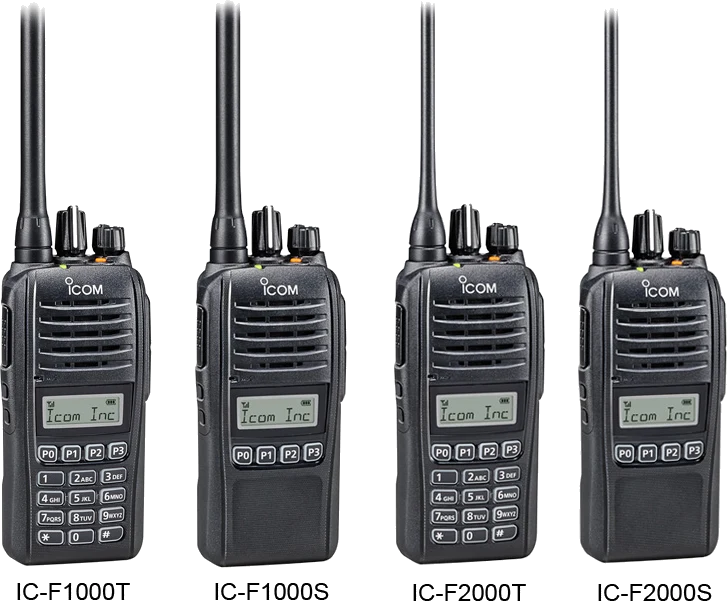
We supply, program, and integrate analog and digital VHF/UHF radios from Motorola Solutions, Hytera, Kenwood, Icom, Entel, and Tait, along with the airband and marine units.
Repeaters and radio sites
We install repeaters and radio sites at altitude and interconnect them with point-to-point microwave links, to extend coverage across valleys, routes, and large areas.
VHF/UHF coverage in tunnels
DAS and radiating cable carry the radio signal inside the tunnel bores. We have installed coverage systems in over 100 tunnels, across more than 500 km of highway routes.
Monitoring VHF/UHF carriers
TP-RFX monitors carriers from 15 MHz to 2.7 GHz 24 hours a day: it covers VHF and UHF along with FM and DAB, and alerts technicians at the first missing signal.
Dispatching and control rooms
Respondr unifies analog VHF/UHF networks, aviation and marine VHF, DMR, TETRA, and cellular PTT in a single operator console. We also supply the Funktronic operator consoles and radio gateways, for which Teleproject is the exclusive distributor for Italy.
Browse the VHF/UHF catalog
The current models from the manufacturers we work with, with specifications and official datasheets: choose a category.
Frequently asked questions about VHF and UHF
Differences, range, licensing, and repeaters: the essential answers to the questions we hear most often.
What is the difference between VHF and UHF?
They are two bands of the radio spectrum: VHF from 30 to 300 MHz, UHF from 300 MHz to 3 GHz. In professional practice the difference is propagation: at the same power, VHF reaches farther in open country, while UHF penetrates better into buildings and urban areas.
What is the range of a VHF/UHF radio?
There is no single number: range depends on the band, power, antenna, and terrain. Radio to radio, you cover a few kilometers; with a repeater in a commanding position you cover a valley or a city. This is why every network starts with a coverage study.
Do you need a license to operate VHF/UHF radios?
Yes, for the professional frequencies: in every European country their use is subject to authorization from the national regulator. PMR446 radios are the exception, license-free throughout Europe.
In Italy. A general authorization with frequency usage rights is required under D.Lgs. 259/2003: the application is submitted to the MIMIT territorial inspectorate and involves administrative fees and annual contributions. PMR446 radios, by contrast, are license-free, with no declarations or fees. Teleproject handles the paperwork on the client’s behalf.
What is a radio repeater?
It is a unit that receives the signal on one frequency and retransmits it on another from a commanding position, a mast or a hilltop. It extends coverage from local to wide-area: the radios communicate through the repeater even when an obstacle blocks the direct link.
Are analog radios still legal and supported?
Yes. Analog VHF/UHF networks remain legal and fully supported, and for many fleets they are still the simplest choice. DMR digital equipment also works in analog: migration to digital can happen in stages, without stopping service.
Who can use aviation VHF and marine VHF?
These are bands reserved for their respective services: to transmit you need type-approved equipment and an operator certificate. Teleproject designs and installs the ground systems for airports, ports, and professional operators.
In Italy. For marine VHF you need at least the restricted radiotelephone operator certificate issued by MIMIT, and for DSC equipment the SRC certificate. For the airband you need the aeronautical radiotelephony authorization issued by ENAC or the Aero Club d’Italia.
Do VHF/UHF radios work in tunnels?
Only if the tunnel is covered: the signal does not reach the bores on its own. Coverage is built with DAS and radiating cable fed by a base station. Teleproject has installed these systems in over 100 tunnels and monitors the carriers with TP-RFX.
Let’s talk about your VHF/UHF radio project.
A new network, a repeater, an aviation or marine system: we take care of design, build, and technical support, with a single point of contact.