
Solutions · Marine equipment and marine VHF
Marine VHF radio equipment: we build the coast station, fit out the vessels, and bring the communications onto the control room console.
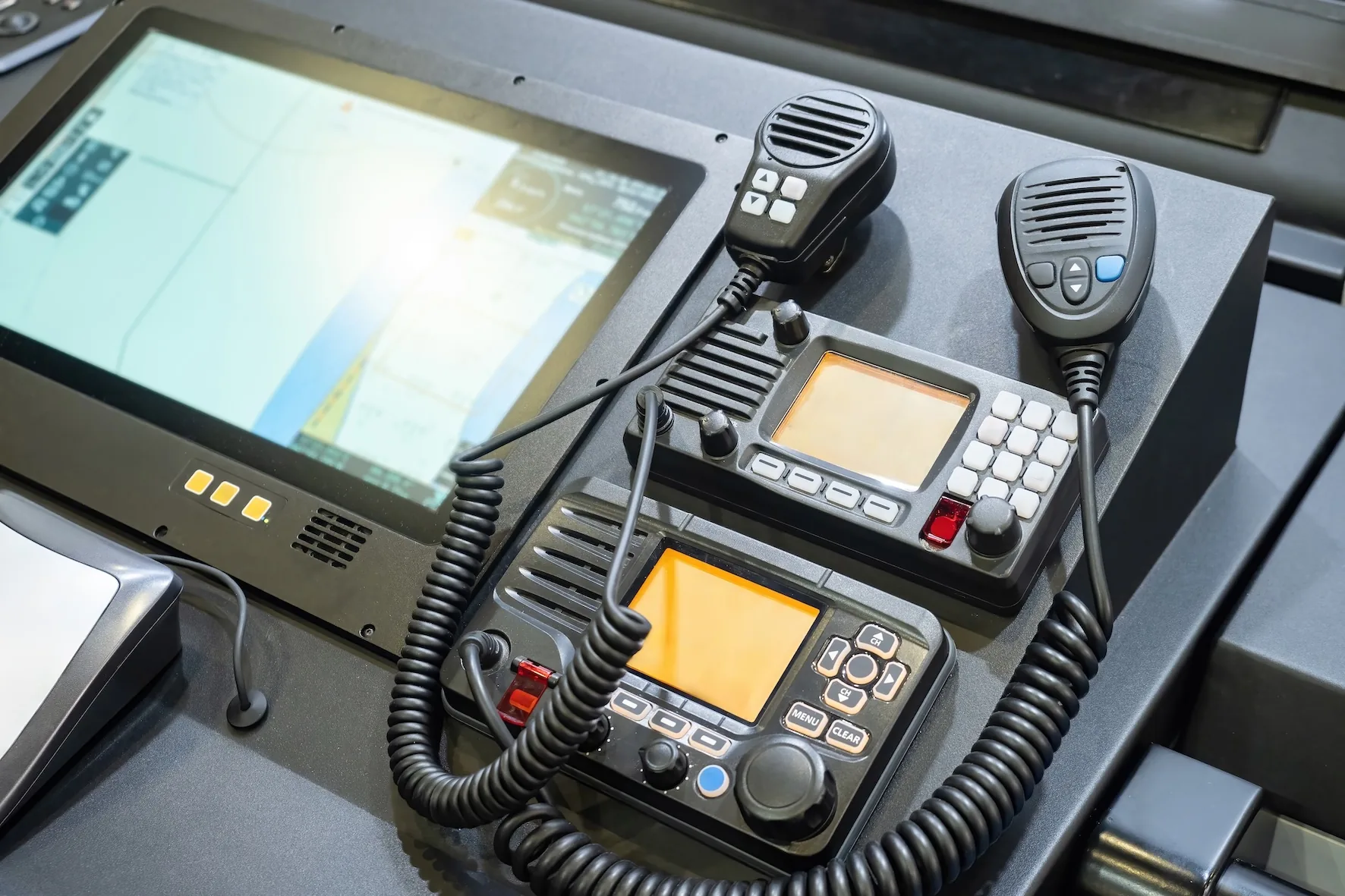
We supply, install, and maintain marine VHF radio equipment for ports and coastal operations: fixed stations in the technical room, on-board equipment on the vessels, antennas and transmission lines at the coastal site. We bring marine VHF to the same operator position as the shore team’s radios, and hand the customer the acceptance measurements and the system documentation.

Communications with vessels travel in the marine VHF band: on one side the on-board unit, on the other a fixed station connected to an antenna on the coast. For a radio installation this is an aggressive environment: salt corrodes connectors, brackets, and fixings, moisture gets into unsealed joints, and transmitted power is lost along the line instead of reaching the antenna. In service the fault always shows up the same way: the vessel’s call comes through noisy, or it does not come through at all.
We design and build the installation as a single system, from the coast station to the operator position. We start with a coverage study over the stretch of water to be served, and on that calculation we choose the position and the type of antenna and the power of the equipment. We fit antennas, brackets, and fixings in corrosion-resistant materials, equip the vessels with on-board units, and bring marine VHF onto the Respondr console alongside the shore team’s radio networks.

What makes a marine VHF installation difficult.
The three difficulties we meet on every marine VHF installation, from the coastal site to the operator position.
Coverage over the water
Range towards the vessels depends on how the coastal antenna is installed: what counts is the height above sea level, a clear line of sight over the stretch of water to be served, and the obstacles in the first stretch. A site chosen without a coverage study leaves dead zones exactly where the vessels maneuver.
Salt and moisture
The equipment at the coastal site works outdoors, in a salt-laden environment. Corrosion attacks connectors, brackets, and fixings, moisture gets into unsealed joints, and the standing wave ratio climbs until the transmitted power is dissipated. In the final result, the choice of materials and the sealing of the joints weigh as much as the radio itself.
Equipment kept apart from the console
In many installations the marine VHF set sits outside the console the operator uses to talk to the shore team: whoever is on shift has to move across the room to answer, and the call does not enter the recordings along with the rest. Bringing the networks together at a single operator position is integration work, not an accessory to the radio.
How a marine VHF installation is built.
The crew on board calls in the marine VHF band, the antenna at the coastal site receives the signal, and the equipment in the technical room carries it to the operator position in the control room.
- Coverage over the water
- The part of the water served by the antenna at the coastal site, sized by the coverage study.
- Over-the-air link
- The dashed line is the marine VHF link between the on-board unit and the coastal antenna.
- Coastal site equipment
- The fixed stations installed in the technical room, connected to the antenna by the downlead cable.
- Control room
- The operator position where marine VHF and the shore staff radios both arrive, with the communications recorded.
What a marine VHF installation includes.
The systems we design, supply, and install, from the coastal site to the operator position in the control room.
Coverage study and design
- Survey of the coastal site and of the stretch of water to be served, checking the obstacles and the height available
- Propagation models and link budget in the marine VHF band, with a coverage map over the water
- Antenna position, antenna type, and equipment power chosen on the basis of the calculation
- RF diagrams, layout drawings, and a bill of materials for the build and for the tender
- Authorization paperwork and frequency licensing with the competent authorities, handled together with the customer
Fixed and on-board equipment
- Marine VHF fixed stations for the technical room at the coastal site
- VHF bridge sets and portable units for the vessels
- Programming of channels and talkgroups, agreed with the customer before handover
- Microphones, loudspeakers, power supplies, and audio accessories for the positions
- Spare units and replacement parts as set out in the supply contract
Coastal site, antennas, and transmission lines
- Marine VHF antennas mounted on a mast or tower, at the height the coverage study calls for
- Masts, towers, and brackets: foundations, anchors, and a check of the tightening torques
- Downlead cables, connectors, and cable entries between the antenna support and the technical room
- Filters, duplexers, and combiners where several radio networks work on the same support
- A technical cabinet or shelter for the equipment, lockable and ventilated
Protection against the salt-laden environment
- Corrosion-resistant materials for antennas, brackets, guy wires, and fixings
- Sealing and taping of exposed connectors, to keep moisture out
- Enclosed cabinets and housings, with an ingress protection rating chosen for coastal exposure
- Surge arresters on the RF lines and bonding of equipment and supports to the earthing system
- Inspection of surfaces, tightening, and seals at every scheduled visit
Positions in the control room
- Respondr console: marine VHF, the shore radio networks, and telephony at the same operator position
- Gateways and audio interfaces between the marine VHF equipment and the dispatch platform
- Echo and feedback cancellation between adjacent positions in the same room
- Console access assigned according to the operator’s role
- Call tests on every channel in service, together with the control room staff
Recording of the communications
- Simultaneous recording of every channel in service, with the retention period set by the customer
- Search of the communications by date, time, channel, group, and radio ID
- Automatic backup of the recordings, to reconstruct events long afterwards
- Access to the recordings restricted to authorized profiles, with a trace of who consults them
Links and shore networks
- Connection of the coastal site to the control room over a fiber backbone or a microwave link
- Shore staff radio networks in DMR Tier II and Tier III, TETRA trunking, or analog VHF/UHF
- Talkgroups shared between marine VHF and the shore teams, defined together with the customer
- Network equipment and patch cabinets in the technical room, PoE powered
- Radio traffic separated from the rest of the network, with the security configuration of the equipment
Acceptance testing, maintenance, and support
- Standing wave ratio and attenuation measurements on antennas and downlead cables
- Link tests with the vessels out to the distance the design calls for
- A maintenance contract with scheduled visits and agreed response times
- Equipment status in Track-TP and monitoring of carrier presence with TP-RFX
- A service report with the measurements taken and the faults found
Learn more.
 Technical
Marine VHF radio: channels, frequencies, and coverage
The marine VHF band spans 156–162 MHz and is divided into internationally standardized channels: channel 16 for distress and calling, channel 70 for Digital Selective Calling (DSC), and dedicated channels for port operations and ship-to-ship communications. Coverage is line-of-sight and depends chiefly on antenna height, geography, and equipment quality — a fixed radio with a properly elevated antenna reaches 20–25 nautical miles in open water.
 Technical
VHF vs UHF: Technical Differences and Applications of Radio Frequencies
VHF or UHF for professional communications: propagation, building and vegetation penetration, antenna dimensions, spectrum availability, and the criteria for choosing the right band in maritime, rural, urban, and industrial environments.
Frequently asked questions.
The questions we are asked most often about this type of system.
Does raising the transmit power extend the range out to sea?
Almost never. In the marine VHF band the link follows the line of sight between the two antennas: if a headland or a building stands between the coastal antenna and the vessel, raising the power does not recover the communication. Range depends far more on the height and the position of the coastal antenna. That is why coverage is calculated first with a radio coverage study over the stretch of water to be served, and then verified with link tests at sea.
What is the difference between marine VHF and a DMR or TETRA radio network?
They serve two different purposes. Marine VHF is the band you use to talk to vessels: the on-board units work on common channels, so a vessel can call the coastal site without belonging to a private network. A DMR or TETRA network, by contrast, is reserved for the organization that runs it and covers the shore teams, with its own talkgroups and its own terminals. In a port the two coexist: that is why we bring marine VHF and the shore staff radios to the same operator position.
Does a radio installation on the coast need more maintenance than one inland?
Yes, and the cause is the salt-laden environment: salt attacks connectors, brackets, and fixings far faster than at a site away from the sea. How often the visits take place depends on how exposed the site is and is agreed with the customer in the maintenance contract. At every visit we check seals and tightening, measure the standing wave ratio on the lines, and check the state of the equipment, so that corrosion is caught before communication with the vessels deteriorates.
Can the marine VHF antenna be installed on a mast that already carries other antennas?
Often yes, but three things have to be checked. The first is the strength of the support, meaning whether the mast or tower can take the load and the wind force with one more antenna. The second is coexistence with the services already present: on the same support the antennas have to be spaced apart, and where several radio networks operate, filters, duplexers, or combiners are added. The third is height, because range out to sea depends on how high the antenna is installed. The survey of the coastal site establishes whether the existing support can be used or a new one is needed.
Request a proposal for marine equipment and marine vhf.
For every project we provide a tailored technical and commercial proposal based on your requirements — feasibility analysis, RF coverage study, and intervention planning.