
Solutions · FM/DAB+ rebroadcast and emergency break-in
We install FM and DAB+ amplification systems inside tunnels, with emergency break-in on the car radios of passing vehicles.
We design, install, and maintain FM and DAB+ rebroadcast systems for road and railway tunnels, built on Teleproject’s TP-DAB. In normal operation drivers keep listening to their own station; in an emergency the system interrupts the programme and transmits the alert message on the car radios of passing vehicles, with independent zones for each tunnel bore.

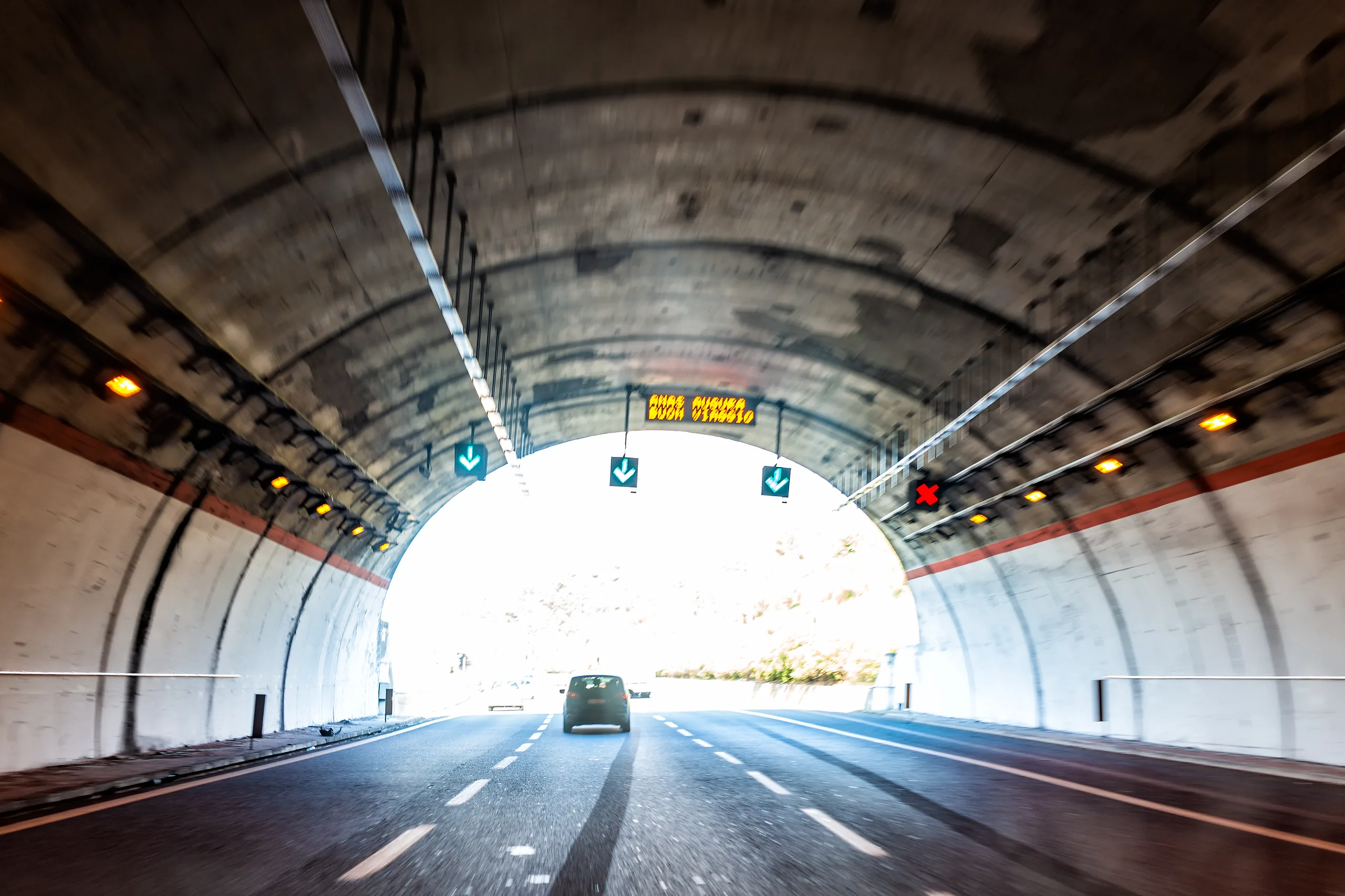
In a tunnel, reinforced concrete shields the FM and DAB+ signals: without an internal rebroadcast system, reception stops at the portal and the operator has no direct channel to the vehicles passing through. Directive 2004/54/EC, transposed in Italy by D.Lgs. 264/2006, requires trans-European network tunnels longer than 1,000 m and carrying more than 2,000 vehicles per lane to have a broadcasting system able to interrupt the programme and transmit safety messages from the control center.
The solution is built on TP-DAB, the digital radio system developed by Teleproject: antennas installed outside pick up the area’s FM and DAB+ signals, the Master Unit in the technical room selects the channels to rebroadcast (up to 32 FM channels and 12 DAB+ ensembles, plus TETRA and VHF channels) and distributes them in digital form over optical fiber to the remote units along the bore, which feed them onto the radiating cable. In an emergency the system interrupts the programme and transmits the alert message (pre-recorded, live from a Respondr console, or from a VoIP call) independently for each bore, also replacing the text shown on the car radio display.
We hand over the system turnkey: we take care of the radio coverage study, the design, the supply and installation, the integration with the control room and the tunnel sensors, the instrumented acceptance testing, and the maintenance. Our experience comes from over 20 years of mission-critical communications and from more than 100 tunnels equipped with radio coverage systems.

Why radio in a tunnel is a safety system.
The three problems an FM and DAB+ rebroadcast system has to solve, from picking up the signals to keeping the service available.
A tunnel is a dead zone
The reinforced concrete and the steel structures of a tunnel attenuate FM and DAB+ signals until penetration is practically nil: without an internal distribution system, reception stops a few meters past the portal. The signal has to be picked up outside with dedicated antennas, reconditioned channel by channel, and radiated along the whole bore through the radiating cable.
The message has to arrive on the station already tuned in
An emergency announcement is only useful if the driver receives it without touching the radio. That is why the choice of channels to rebroadcast follows the listening habits of the area: the break-in transmits the announcement on the same FM frequency or the same DAB+ multiplex already tuned in, and also replaces the text shown on the car radio display.
A safety system has to stay ready at all times
The break-in is used a handful of times in the life of the system, but it has to work on the first command. DM 12/07/2021 strengthened the obligations for scheduled maintenance and monitoring of tunnel safety systems, broadcasting systems included: that is why we provide a standby Master Unit with automatic resource remapping and documented periodic tests.
How an FM and DAB+ rebroadcast system with break-in is built.
The Master Unit receives the signals from the outdoor antennas and distributes them over optical fiber to the remote units, which feed them onto the radiating cable of each bore. The control room and the tunnel sensors trigger the break-in.
- Technical room at the portal
- The technical room at the portal, highlighted in the diagram, houses the Master Unit, which receives the signals from the outdoor antennas, selects the channels to rebroadcast, and generates the break-in.
- TP-DAB units
- The Master Unit and the remote units are the equipment of the system, connected to each other over optical fiber: the remote units feed the signals onto the radiating cable of their own bore.
- Control room, sensors, and car radios
- The control room and the tunnel sensors trigger the break-in; the car radios receive the programmes and the alert messages. These are the elements outside the TP-DAB equipment.
- Break-in command
- The emergency commands reach the Master Unit from the control room console, from a VoIP call, or from the tunnel sensors over API and SNMP.
What an FM/DAB+ rebroadcast system in a tunnel includes.
The subsystems we install and the checks we use to verify them, from the outdoor antennas to the emergency break-in.
Outdoor reception of the signals
- Receive antennas installed outside the tunnel, aimed at the FM and DAB+ transmitters serving the area
- Measurement of the received levels of the FM stations and DAB+ ensembles considered for rebroadcast
- Choice of the channels to rebroadcast based on the stations people actually listen to in the area
- Downlead cables, surge arresters, and bonding to the earthing system
- Verification of the aim and of the mechanical fixings at every maintenance visit
Master Unit in the technical room
- A TP-DAB Master Unit installed in a rack cabinet in the technical room, reconditioning the signals channel by channel
- Sub-band filtering and automatic gain control on every rebroadcast FM channel and DAB+ ensemble
- Up to 32 FM channels and 12 DAB+ ensembles per unit, with repetition of TETRA and TETRAPOL as well, and VHF/UHF optional
- A standby Master Unit with automatic resource remapping in the event of a failure
- Dual power input, from the 230 VAC mains and from a 48 VDC supply
Optical distribution along the bore
- An optical fiber backbone from the Master Unit to the remote units, with the signal carried in digital form (CPRI)
- Star, cascade, or redundant topology, with up to 16 optical links per unit
- Remote units in a compact outdoor enclosure, suited to the tunnel environment from −20 to +55 °C
- Digital transport with no signal degradation, and a better signal-to-noise ratio than analog links
- A switchover test on the redundant optical path, where the design provides one
Radiating cable and distribution in the bore
- RF outputs of the remote units connected to the radiating cable running along the bore
- Power levels set channel by channel to the design values, up to 30 dBm per channel
- Verification of the FM and DAB+ signal levels along the whole tunnel
- Coexistence on the same radiating cable with the other distributed services, such as TETRA, DMR, and cellular
- Pairing with TP-CCV2, the Teleproject system that monitors radiating cable continuity
Multi-zone emergency break-in
- Independent break-in zones for each bore: the message is transmitted only where it is needed
- A choice of audio sources: a pre-recorded message from the library, a live voice announcement, or a VoIP call
- Replacement of the audio and of the text shown on the car radio display; on DAB+ the break-in can also send an image
- Periodic testing of the break-in with test messages, documented in the unit’s event log
Activation from the control room and from the sensors
- Manual activation from the Respondr console: the operator selects the bores and starts the message, pre-recorded or live
- A direct SIP VoIP call to the system: the operator’s voice is transmitted in real time on the active FM frequencies and DAB+ multiplexes
- Automatic activation over API or SNMP from the tunnel monitoring systems, such as smoke sensors and incident detectors
- GPIO contacts for integration with the tunnel systems already in service
Supervision, diagnostics, and maintenance
- Supervision from the built-in web interface and forwarding of alarms over SNMP to the operator’s monitoring system
- Diagnostics built into the unit: a spectrum analyzer on the RF inputs and outputs, VSWR measurement, and distance-to-fault measurement
- An event log with the break-in activations and the faults detected
- Scheduled maintenance visits as required by DM 12/07/2021 for tunnel safety systems, with a written report for every visit
Learn more.
 DAB
DABThe FM and DAB+ Break-In System in Tunnels
How the VBI (Voice Break-In) system interrupts in-vehicle radio to broadcast emergency messages inside tunnels: intelligent amplifier architecture, automatic activation via API/SNMP and manual activation via SIP VoIP, DAB+ text and image support, and regulatory obligations under EU Directive 2004/54/EC and Legislative Decree 264/2006.
 DAB
DABDAB+ and FM Coverage in Tunnels: Radio Systems for Road and Highway Tunnels
How to bring FM and DAB+ signal inside tunnels, how the VBI emergency break-in system works to reach vehicles in transit, and what Directive 2004/54/EC and Legislative Decree 264/2006 require for tunnels on the trans-European network.
 DAB
DABFM, DAB, and DVB-T2: frequencies and signal monitoring
How to monitor FM, DAB, and DVB-T2 signals: the key parameters to track, continuous monitoring methodologies, and the TP-RFX solution for outdoor installations.
Frequently asked questions.
The questions we are asked most often about this type of system.
When is break-in in a tunnel mandatory?
Directive 2004/54/EC, transposed in Italy by D.Lgs. 264/2006, requires emergency communication systems with a break-in function in trans-European network tunnels longer than 1,000 m carrying more than 2,000 vehicles per lane: in those cases the broadcasting system has to be able to interrupt the programme in order to transmit safety messages from the control center. Operators may also provide rebroadcast and break-in in shorter tunnels, where the risk analysis or the traffic conditions call for it. DM 12/07/2021 further strengthened the obligations for scheduled maintenance and monitoring of safety systems, broadcasting systems included.
What is the difference between break-in on FM and on DAB+?
On both technologies the announcement replaces the audio of the station already tuned in: the car radio receives the new signal on the same FM frequency or the same DAB+ multiplex, without the driver having to touch anything. The system also replaces the text shown on the car radio display; on DAB+ the break-in can additionally send an image, for example an emergency symbol that is recognizable even to someone who does not understand the language of the announcement. For DAB+, the EN 300 401 standard defines the "Alarm Announcement" function, while ETSI TS 102 182 describes how break-in is integrated into tunnel broadcasting systems.
Does TP-DAB work with the radiating cable and the DAS already installed?
Yes. TP-DAB is the active source of the signals, while the radiating cable is the medium that distributes them along the bore: if the tunnel already has a radiating cable installation, the remote units connect to the existing sections, provided the FM and DAB+ frequencies fall within the passband of the cable and of the components installed. The other tunnel services, such as TETRA, DMR, and cellular, can also share the same radiating cable, each with its own band and its own levels. During design we check the existing sections and size the injection levels service by service.
Who triggers the emergency message, and how quickly?
The message is triggered in two ways. Manually, by the control room operator: from the Respondr console they select the bores and start the announcement, pre-recorded or live, or they call the system over SIP VoIP and their voice is transmitted in real time on the active FM frequencies and DAB+ multiplexes. Automatically, by the tunnel monitoring systems integrated over API or SNMP: smoke sensors, incident detectors, and video surveillance. In both cases activation is instantaneous.
How many bores and how many break-in zones does one system handle?
The break-in zones are independent for each bore: the operator can send the announcement into a single bore or into all of them, according to the design configuration. One Master Unit handles up to 16 optical links to the remote units, in star, cascade, or redundant topology, and rebroadcasts up to 32 FM channels and 12 DAB+ ensembles. The system scales through licences: RF inputs, outputs, optical links, and functions are enabled when they are needed, without replacing the unit.
How is the system maintained and diagnosed?
Supervision runs through the built-in web interface, with alarms forwarded over SNMP to the operator’s monitoring system and an event log holding the break-in activations. Diagnostics are built into the unit: a spectrum analyzer checks the RF inputs and outputs, while VSWR and distance-to-fault measurements pinpoint problems on the RF chain. If a failure occurs, the standby Master Unit takes over with automatic resource remapping. Our technicians carry out the scheduled maintenance visits required by DM 12/07/2021 for safety systems and issue a written report for every visit.
Request a proposal for FM/DAB+ rebroadcast and emergency break-in.
For every project we provide a tailored technical and commercial proposal based on your requirements — feasibility analysis, RF coverage study, and intervention planning.