
Solutions · Lone worker protection
Man-down, lone worker, and emergency button: we configure the safety functions of the radio terminals and bring the alarms into the control room.
Many professional DMR, TETRA, and VHF/UHF radio terminals have built-in man-down and lone worker safety functions. We configure them together with the safety manager on the terminals that provide them, and connect the alarms to the control room: the console receives the emergency call with the GPS position of the terminal.

On construction sites, in industrial plants, and in underground infrastructure, a lot of work is done alone: the security patrol, an inspection in a technical room, a maintenance job away from the rest of the team. If the worker falls or loses consciousness, no colleague is there to raise the alarm. D.Lgs. 81/2008 requires the employer to assess the risk of working alone as well, and to adopt adequate measures.
The functions you need are already built into professional radios, with no extra devices. Man-down uses the terminal’s accelerometer: the alarm goes out if the radio stays tilted beyond a set angle for a set time, if it stops moving, or if it takes a sudden impact, along with the GPS position. Lone worker instead monitors periods of inactivity, with a pre-alarm and then the full alarm to the control room. The emergency button goes out with a single press and has absolute priority on the network.
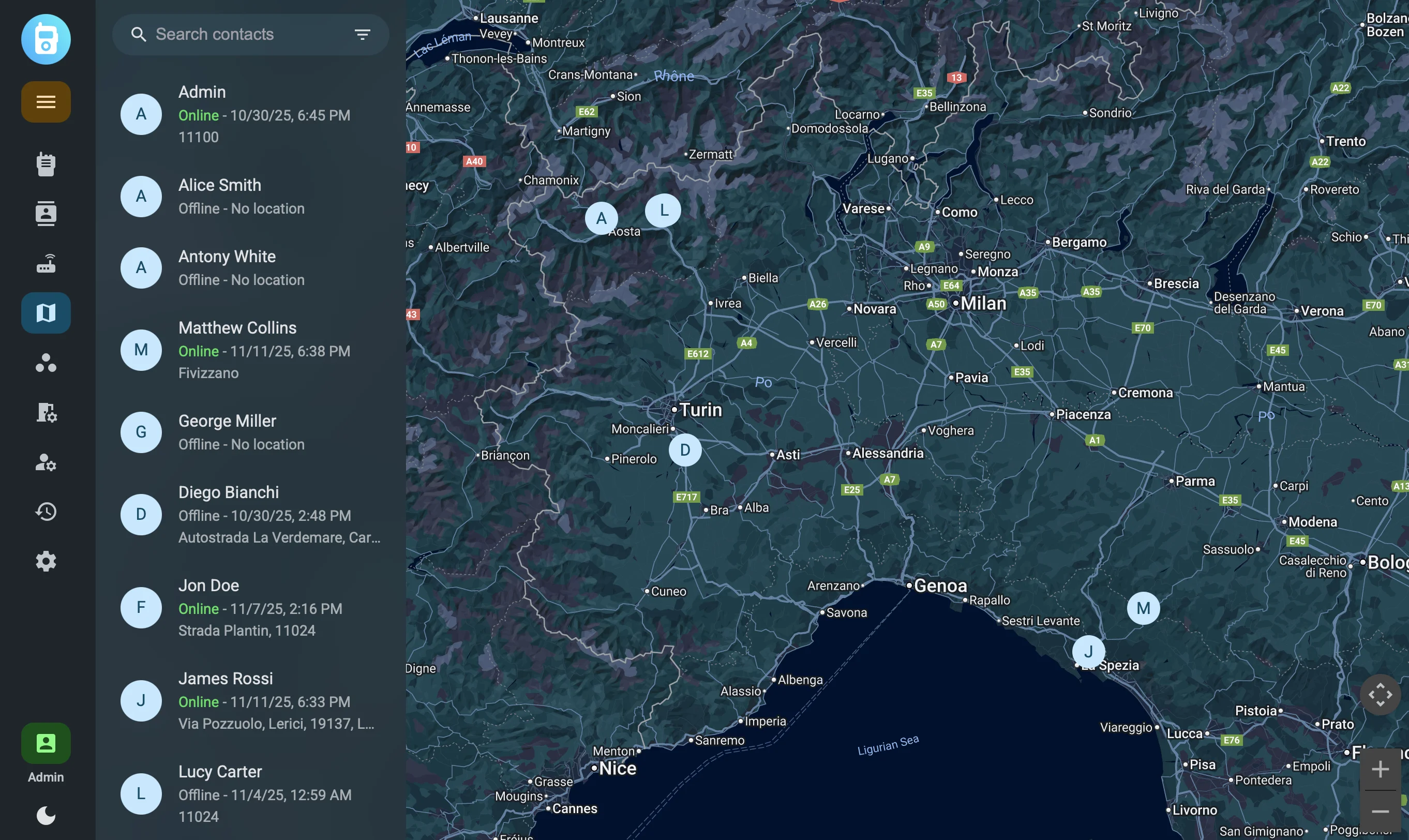
We supply the terminals that provide these functions and integrate them into the network already in service: we set the thresholds together with the safety manager and bring the alarms onto the operator console, where Respondr handles man-down, individual call, messaging, and GPS position from the same position.

What makes it hard to protect people who work alone.
The three points where a lone worker protection system can fail, and how we address them during configuration.
Raising the alarm when the worker cannot
After a fall or a loss of consciousness the worker cannot press any button. That is why the man-down function requires no action at all: the motion sensor detects that the radio has stayed tilted beyond a set angle for a set time, and the terminal sends the alarm automatically, with the GPS position of the point where the worker is.
Avoiding false alarms
If the thresholds are too sensitive, the control room gets an alarm at every sharp movement and the staff stop treating them as reliable. The man-down angle and delay and the lone worker inactivity interval are set according to the task, together with the safety manager; the pre-alarm sounds on the terminal first, so the worker can respond and avoid sending an unnecessary alarm.
Getting the alarm through
The emergency button and man-down need radio network coverage to deliver the alarm: where coverage is missing — in a tunnel, on underground levels, or at the edges of the served area — the alarm reaches nobody. That is why we verify coverage at the points where people work alone: coverage design is an integral part of the safety system.
How the alarm travels from the radio to the control room.
The terminal detects the fall or the inactivity and sends the alarm with its GPS position over the radio network; the console presents it to the operator, who verifies with an individual call and coordinates the response.
- The worker’s terminal
- The portable radio carries all three safety functions: the motion sensor for man-down, the inactivity timer for lone worker, and the emergency button with priority on the network.
- Radio network
- The DMR, TETRA, or PoC network already in service carries the alarm from the terminal to the control room: the safety functions need radio coverage at the point where the work happens.
- Control room
- The console receives the alarm with the terminal’s GPS position on the map: the operator checks the situation with an individual call and coordinates the response at the point indicated.
- The alarm path
- The dashed lines follow the alarm from the terminal to the console: the transmission is automatic and has absolute priority on the network.
What lone worker protection includes.
The work we do to configure the safety functions of the terminals and connect them to the control room, from the risk analysis to the training.
Risk analysis and terminal review
- A census of the tasks carried out alone and of the working environments, together with the safety manager
- Definition of the functions required: emergency call, man-down, GPS location
- A review of the radio fleet in use: which terminals provide the safety functions and which are worth replacing
- Choice of the management level: functions enabled by the worker, or monitoring from the control room
- Ingress protection rating and mechanical strength of the terminals suited to the working environment
Terminals with safety functions
- DMR, TETRA, and VHF/UHF portables with a motion sensor for the man-down function
- The lone worker function on the terminals that provide it, with an inactivity timer and pre-alarm
- A dedicated emergency button on the radio portables and on the PTT terminals over the cellular network
- Built-in GPS to send the position along with the alarm
- Units with ingress protection up to IP68 and MIL-STD-810 durability for the toughest environments
Configuration of the thresholds and the alarms
- Tilt angle and delay of the man-down function set according to the task
- Inactivity interval and pre-alarm for the lone worker function agreed with the safety manager
- Emergency button configured to reach the control room directly
- Alarm call with absolute priority on the radio network
- The same programming across every terminal in the fleet, so no unit is left in the field without the functions enabled
Alarms in the control room
- Funktronic consoles and the Respondr platform: GPS location and man-down alarm at a single operator position
- Man-down alarm handling from the Respondr console on Motorola, Hytera, and Kenwood DMR radios
- GPS position of the radios in the field, shown on the console map
- Individual call and text messages to the terminal that sent the alarm
Radio coverage where the work happens
- Verification of radio coverage in the areas where people work alone
- Call and alarm tests at the critical points: underground levels, technical rooms, and the edges of the served area
- Coverage design where it is missing, in tunnels and underground spaces too: without coverage the alarm is not delivered
- Field measurements before the safety functions enter service
Training and emergency procedures
- Training for the teams on using the terminals, the emergency button, and the safety functions
- Courses for control room operators on handling the alarms from the console
- Tests of the emergency procedures with the control room staff and with the teams
- User manuals and operating sheets handed over together with the equipment
Learn more.
Frequently asked questions.
The questions we are asked most often about this type of system.
Which radios have the man-down and lone worker functions?
On many professional terminals they are standard functions, or can be enabled in programming, and availability varies from model to model. Among the units we distribute: the Motorola R7 lists both man-down and lone worker on its data sheet, in the keypad and the non-keypad versions; on the MOTOTRBO DP4000e series, integrated man-down is provided on the DP4401e, DP4601e, and DP4801e models; on the Hytera HP series the two functions are optional and are enabled in programming; the Kenwood NX-3000 pairs the lone worker function with fall, immobility, and motion detection through its acceleration and tilt sensors. During the analysis stage we check which of the terminals already in use provide them and which have to be replaced.
What is the difference between man-down and lone worker?
They are two complementary functions of the same terminal. Man-down uses the motion sensor: if the radio stays tilted beyond a set angle for a set time, the typical situation after a fall or a loss of consciousness, the terminal sends the alarm automatically with the GPS position. Lone worker instead monitors periods of inactivity: if the terminal records no activity for a defined interval, it raises a pre-alarm and, if there is no response, the full alarm reaches the control room.
Is the employer required to protect people who work alone?
D.Lgs. 81/2008 requires the employer to assess every risk, including the risks of working alone, and to adopt adequate measures. Man-down and lone worker systems are among the most effective technical measures for high-risk environments. The risk assessment remains the employer’s responsibility: we configure the terminal functions and the trigger thresholds together with the safety manager.
Do you need a dedicated radio network to enable these functions?
No. The man-down, lone worker, and emergency button functions run on the DMR or TETRA network already in service, with no extra equipment; where teams work over the cellular network we supply PTT terminals with a dedicated emergency button. What you do need is radio coverage at the point where the work happens: the alarm reaches the control room only if the network receives it. That is why we verify coverage in the work areas and, where it is missing, coverage design becomes part of the safety project.
How do you avoid false alarms?
With the right thresholds and with the pre-alarm. The man-down tilt angle and delay and the lone worker inactivity interval are set according to the task, together with the safety manager: a threshold that is too sensitive produces pointless alarms, one that is too permissive delays the response. The pre-alarm sounds on the terminal first: if the worker responds, no alarm is sent to the control room.
Does the worker’s position reach the control room?
Yes. The alarm can include the terminal’s GPS position, and the console shows it on the map at the operator position: the operator sees who sent the alarm and where they are, checks the situation with an individual call or a text message, and coordinates the response at the point indicated.
Request a proposal for lone worker protection.
For every project we provide a tailored technical and commercial proposal based on your requirements — feasibility analysis, RF coverage study, and intervention planning.