
Solutions · Radio fleet supply and management
We supply the radio terminals, program them for the customer’s network, and manage their maintenance over the years.
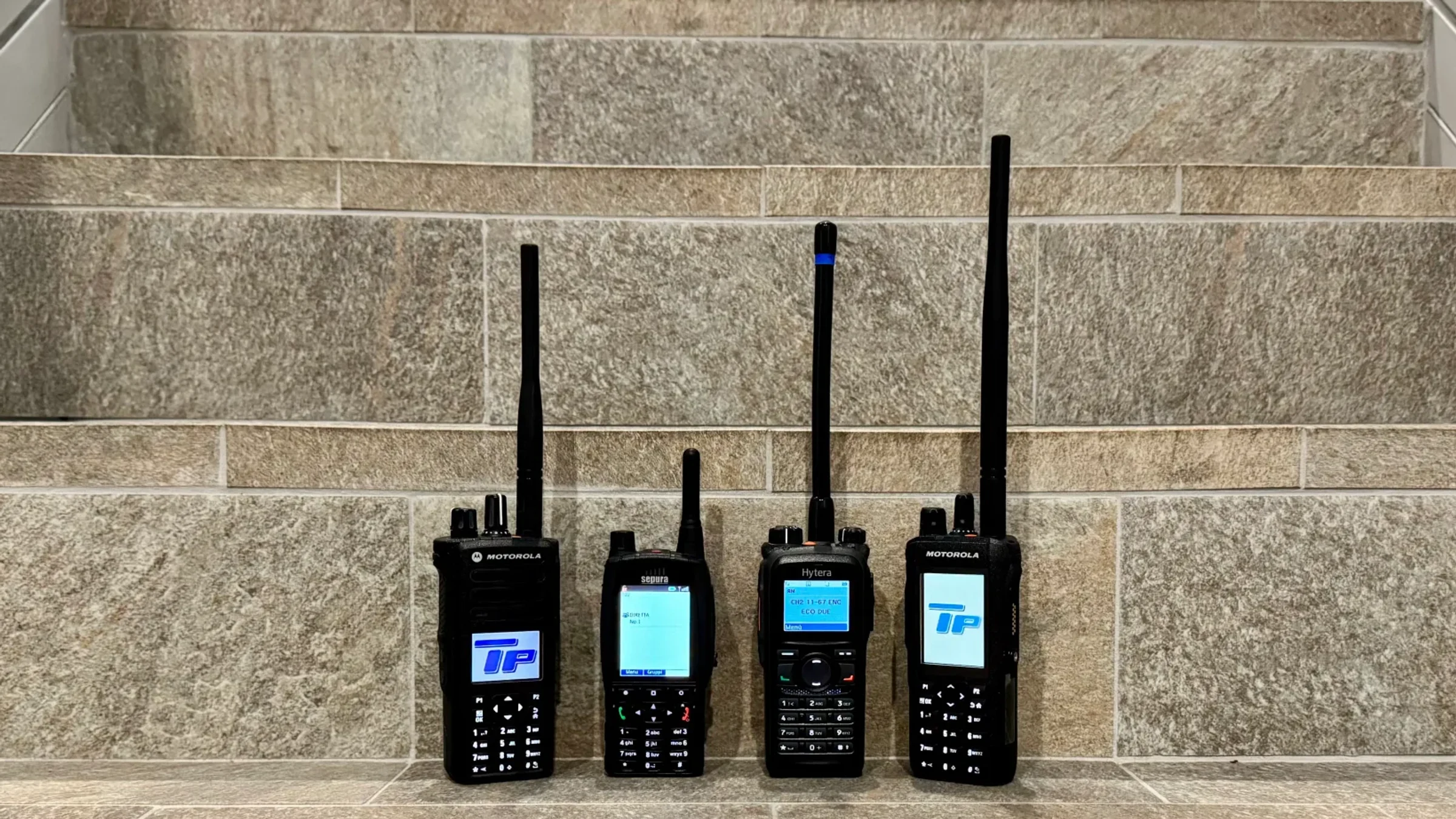
We select and supply portable, vehicle, and fixed terminals for DMR, TETRA, and analog VHF/UHF networks and for Push-to-Talk over the cellular network. We are the exclusive Funktronic distributor for Italy and an authorized reseller for Motorola Solutions, Hytera, and Kenwood: we program the codeplugs, deliver the equipment, handle the repairs, and plan the replacement cycles.

A radio fleet does not fail all at once: it degrades one unit at a time. Batteries lose autonomy with charging cycles, and at the end of a shift a portable shuts down earlier than expected. A terminal replaced in a hurry is handed over with a different configuration from the rest, and whoever receives it cannot find the talkgroup they need. A lost unit stays on the list because the inventory was not updated. A firmware update installed on only part of the fleet leaves two different configurations in service on the same network. These are management problems, not network problems: the system works, but the team in the field cannot communicate.
That is why we treat a radio fleet as an installation, not as a simple supply. We start from a needs analysis: how many teams are working, in what environments, and with which functions (emergency call, man-down, GPS location, encryption). We are the exclusive Funktronic distributor for Italy, an authorized reseller and integrator for Motorola Solutions, Hytera, and Kenwood, and a reseller for six other manufacturers: we choose the terminals to suit your requirements and not to fit a single catalog. Our work does not end at delivery: we program the codeplugs, label the equipment, handle repairs and replacements, and keep the inventory and the firmware versions up to date. The work follows the procedures of our ISO 9001:2015 certified quality management system.

What makes a radio fleet hard to manage.
Three problems that come up over the years even when the radio network works.
The right terminal for the working environment
A portable chosen on price alone turns out to be unsuitable on the very first shift: the keys are too small to press with gloves on, the loudspeaker cannot be heard over the ambient noise, the ingress protection rating is not enough for water and dust. A terminal is chosen from the environment it is used in and from the network already in service, not from a catalog.
One single configuration across the whole fleet
Talkgroups, channels, and priorities have to be identical on every unit. If a replacement terminal arrives with an old configuration, whoever receives it cannot find the group they need and is left isolated exactly during the emergency. The same goes for firmware: if the update reaches only part of the fleet, two different configurations stay in service on the same network.
Availability of the equipment over the years
Batteries lose autonomy with charging cycles, chargers fail, terminals get dropped and damaged. Without spares in stock and without a replacement unit already programmed, every failure takes a radio away from the team until it comes back from repair.
The life cycle of a radio fleet.
The six stages we repeat on every fleet we manage, from the choice of terminals to the renewal of the equipment. The store and workshop at our premises supply the spare parts and the replacement units.
- The stages of the cycle
- The six stages we repeat on the customer’s radio fleet, from the choice of terminals to the renewal of the equipment.
- Store and workshop
- Our premises: the terminals and spare parts in the store, the repairs and functional tests in the workshop.
- Movement of the equipment
- The terminals leave our premises for the customer’s teams and come back to us for repair or replacement.
What managing a radio fleet includes.
The work we carry out on the customer’s radio fleet, from the choice of terminals to training the people who use them.
Needs analysis and choice of terminals
- A census of the teams, the shifts, and the environments the terminals are used in
- Choice of the radio technology: DMR Tier II and Tier III, TETRA, analog VHF/UHF, or Push-to-Talk over the cellular network
- Compatibility with the radio network already in service and with the authorized frequencies
- Functions the service requires: emergency call, man-down, GPS location, encryption
- Ingress protection rating, mechanical strength, and the requirements of explosion-risk areas
The manufacturers we supply and support
- Funktronic: exclusive distributor for Italy
- Motorola Solutions, Hytera, and Kenwood: authorized reseller and integrator
- Radio Data, Tait, RugGear, iSafe, Telox, and Inrico: reseller and integrator
- Sales, integration, and technical support on the equipment of every manufacturer we carry
Programming, codeplugs, and firmware
- Definition of the fleetmap together with the customer: talkgroups, channels, priorities, and user profiles
- Programming of the codeplug, meaning the configuration loaded onto every portable, vehicle, and fixed terminal
- Configuration of emergency calls, individual calls, and encryption
- An archive of the configurations, so a replacement unit can be reprogrammed with the same fleetmap
- Firmware versions kept aligned across terminals of the same model, with functional tests after every update
Batteries, chargers, and accessories
- Spare batteries and single or multi-bay chargers for the control rooms, the vehicles, and the technical rooms
- Speaker microphones, earpieces, and headsets chosen for the noise level of the working environment
- Cases, belt clips, antennas, and power cables for the vehicle terminals
- Planned replacement of batteries that no longer hold up for a full shift
Delivery, labeling, and entry into service
- Labeling of every unit with its serial number and radio ID
- Power-on, call, and transmission tests before delivery
- Installation of the vehicle terminals on board: antenna, power supply, and microphone mount
- Delivery accompanied by the equipment list and its assignment to the teams
Repairs and replacements
- Diagnosis and repair of faulty terminals in our workshop
- Replacement units already programmed with the customer’s fleetmap, so the team is never left without a radio
- Handling of warranty claims and spare parts with the manufacturers
- Verification of power, sensitivity, and battery condition before the unit goes back
Radio fleet inventory
- An up-to-date list of serial numbers, radio IDs, models, and assignees
- The repair and replacement history of every unit
- Disabling of a lost unit: its ID is removed from the network fleetmap
- A periodic report on the state of the fleet, useful for planning replacement cycles and new supplies
Training for the people who use the radio
- Day-to-day use of the terminal: switching on, changing talkgroup, group call, and individual call
- Emergency call and the procedures agreed with the control room
- Battery care and correct use of the chargers
- A quick reference card to keep in the vehicles and the control rooms
Learn more.
 Technical
PMR Radio Costs, Fees, and Licenses in Italy
What it costs to obtain and maintain a licensed PMR frequency authorization in Italy: application fees (€100–€3,000), annual per-device fees, scarce-resource contributions, and exemptions for Protezione Civile and volunteer organizations.
 DMR
DMRPMR446: frequencies, channels, power, and DMR Tier I
What PMR446 is and when it is enough: the 446 MHz license-free band, 0.5 W power limit, real-world range, a comparison with digital DMR Tier I and licensed professional PMR, and the criteria for knowing when dedicated frequencies are required.
 DMR
DMRSwitching from analog PMR to digital DMR two-way radios
Why migrate from analog PMR to DMR: double capacity on the same frequencies with TDMA, clear digital audio to the edge of coverage, AES encryption, and a phased mixed-mode migration that keeps operations running throughout the transition.
Frequently asked questions.
The questions we are asked most often about this type of system.
Can I add terminals from a different manufacturer to an existing fleet?
Yes, provided they work on the same radio standard already in service. On a DMR or TETRA network, terminals from different manufacturers talk to each other for the basic functions: voice, group call, and individual call. The advanced functions, such as some encryption modes, location, or messaging, are often implemented in a proprietary way and do not carry across from one manufacturer to another. Before putting different brands side by side, it is worth listing the functions the teams actually use and testing them on the new units, before ordering the whole supply.
What is the difference between a portable and a vehicle terminal?
A portable is carried by the operator and runs on a battery; a vehicle terminal is installed on board and powered by the vehicle’s electrical system. The vehicle terminal transmits at higher power and uses a roof-mounted antenna, so on the same network it reaches greater distances; the portable has the advantage of staying with the person even when they leave the vehicle. Many teams use both: the vehicle terminal while travelling, the portable while working on the ground. The choice starts from how the team works and from the environments it has to move through.
Can the radio fleet be renewed gradually, without replacing everything at once?
Yes, and it is the most common choice when there are many units: the renewal is spread across several supplies, one team or one site at a time. Old and new units stay in service on the same network as long as they share the radio standard and the same configuration, so every batch has to be programmed with the fleetmap in use and tested before delivery. It is worth setting the order of the batches from the start, usually beginning with the teams that have the oldest units, and keeping a few radios from the old supply aside as spares until the renewal is complete.
How long does a radio terminal last before it has to be replaced?
There is no fixed lifetime: it depends on the environment the terminal is used in and on how hard it is worked. The battery is the first part to wear out, because it loses autonomy with charging cycles, and it is usually replaced several times over the life of the unit. What triggers the renewal is usually not a failure but one of two conditions: the manufacturer stops supplying spare parts for that model, or the network introduces functions the older terminals do not support. Keeping the equipment list up to date, with the year of purchase and the repair history, lets you plan the spend instead of facing it as an emergency.
Request a proposal for your radio fleet.
For every project we provide a tailored technical and commercial proposal based on your requirements — feasibility analysis, RF coverage study, and intervention planning.