
Solutions · Control rooms and dispatch
We design, build, and maintain your control room: operator positions, dispatch platform, and gateways to the radio networks.
We design and build integrated dispatch centers that bring several radio networks together in a single interface: TETRA, DMR Tier II and Tier III, P25, analog VHF/UHF, and PoC at the same operator position. The rooms are built on the Respondr platform and on Funktronic consoles and gateways, for single-site or multi-site installations and for multi-agency environments.

In a control room the operator has to talk to every team in the field, whatever radio network they work on. When each network has its own dedicated equipment, the operator moves from one microphone to the next, calls overlap, and reconstructing a communication afterwards becomes difficult.
That is why we design the room as a single system, built on the Respondr platform and on Funktronic products, for which we are the exclusive distributor for Italy. The consoles bring TETRA, DMR Tier II and Tier III, P25, and analog VHF/UHF networks together at the same operator position, along with PoC calls over the cellular network; the gateways connect each network to the platform, which records the communications, shows the GPS position of the teams, and manages operator profiles.
The supply is turnkey: we assemble and wire the positions in our workshop, install the servers in a redundant configuration, and connect the gateways to the networks in service. We test every channel, train the operators, and, with the maintenance contract, remain your single point of contact after handover too.

What makes an integrated control room difficult to build.
The three problems that stop a dispatch center working as intended, and how we solve them during design.
Many networks, a single operator position
Operations, emergency response, and maintenance teams often work on radio networks of different standards: TETRA, DMR, analog VHF/UHF, and increasingly PoC over the cellular network. Without an integrated console the operator handles one device per network, with separate microphones and separate recordings. The gateways connect each network to the platform, and the console brings every channel together in the same interface.
The room cannot stop
A control room is in service around the clock, and a server failure cannot interrupt communications. That is why we install the platform on two nodes in active and standby mode: if the active node fails, the operators keep working on the standby node, the session stays live, and the communications history is not lost.
Several rooms and several agencies on the same system
On multi-site installations and in multi-agency environments, each organization has to work on its own channels without disturbing the others. Operator profiles establish which networks and which groups each operator can talk on, the audio management removes echo and feedback between adjacent positions, and every action is logged with the identity of the person who performed it.
How an integrated control room is built.
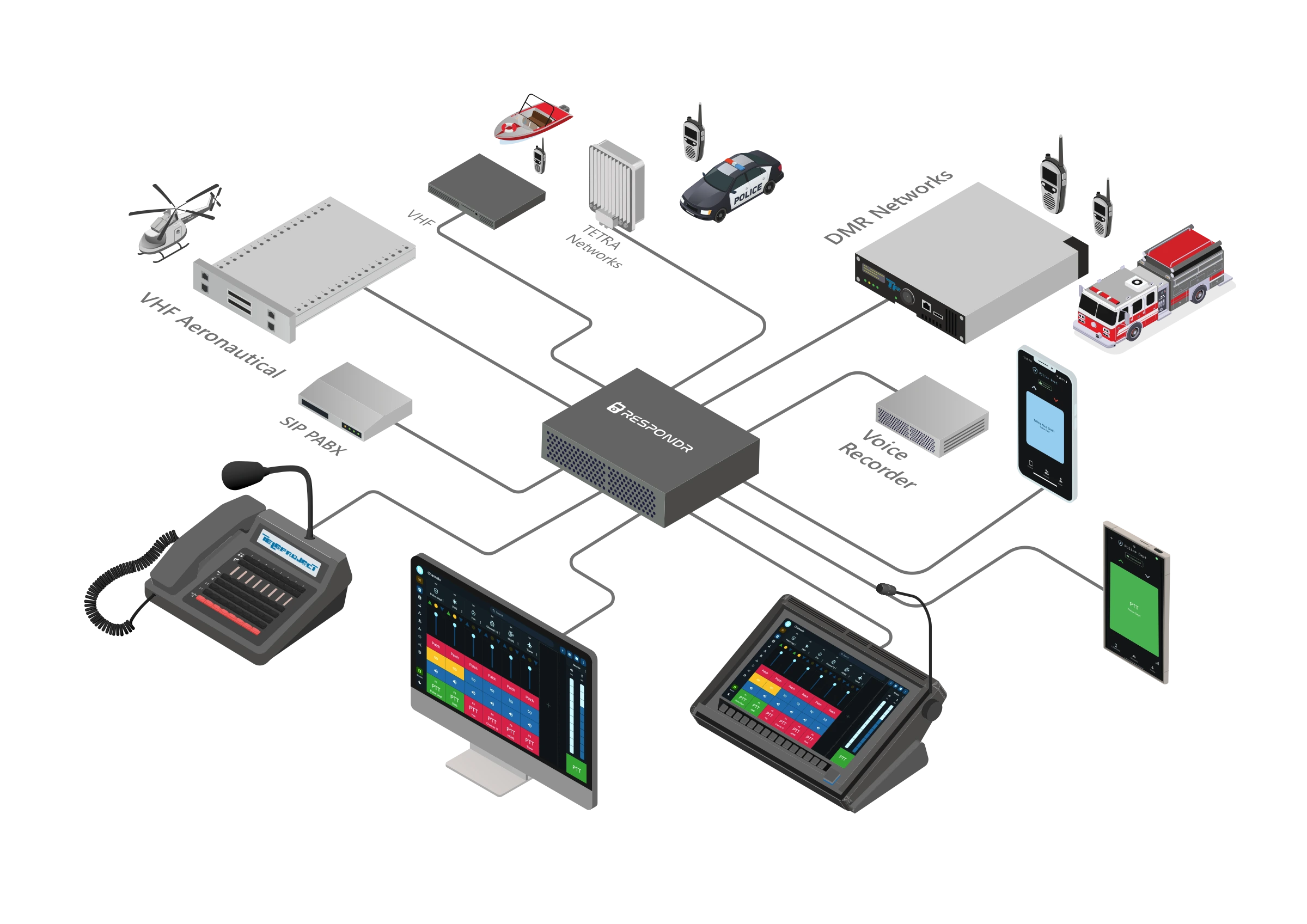
The operator positions are connected to the Respondr platform over the room’s IP network; the gateways and the base stations connect the platform to the radio networks, while PoC calls reach the platform directly over IP.
- Operator positions
- The Respondr consoles talk to the platform over the room’s IP network; the Funktronic consoles connect directly to the FT638 and FT636B gateways.
- Respondr platform
- The heart of the room: two servers in active and standby mode handle channels, operator profiles, recording, and GPS location of the teams.
- Gateways and base stations
- The FT638 gateway reaches DMR and TETRA networks with a donor radio, the FT636B gateway connects to the base stations through the 4-wire E/M interface; the platform can also reach the base stations directly over IP.
- Links to the networks
- The dashed lines represent the links that carry audio and data between the room, the radio networks, and the PoC terminals on the cellular network.
What a complete control room includes.
The systems we hand over and the checks we use to verify them, from the operator positions to the connected radio networks.
Operator positions
- Respondr Mini, Pro, and Max consoles, chosen by the number of radio channels: up to 3, up to 12, more than 12
- Funktronic Major BOS consoles in the 8, 4V, 4VD, and 1V versions, chosen by the room’s channel count and PoE powered over a single RJ45 cable
- Headsets, microphones, and PTT buttons at every operator position
- Advanced functions on Pro and Max: replay of the latest transmissions, GPS position, and multi-group channels
- A general PTT to talk on every channel at once, available on both Respondr and Funktronic consoles
- Positions assembled and wired in our workshop, then installed and tested in the room
Servers and the Respondr platform
- The platform installed in the AWS cloud, on servers at the customer’s premises, or in a mixed configuration
- Two nodes in active and standby mode, with continuous health monitoring and automatic switchover to the standby node
- An operations log replicated synchronously between the nodes
- TLS 1.3 and AES-256 encryption on every communication
- Role-based access control (RBAC) and authentication with corporate credentials (SSO)
Gateways to the radio networks
- Funktronic FT636B gateway: connects any radio network through a 4-wire E/M interface
- Funktronic FT638 gateway for DMR Tier II and Tier III networks and for TETRA networks
- Radio Activity and Kenwood NXR base stations where direct access to the analog or DMR network is needed
- Channel configuration on the console: the name and talkgroup of each channel
- Transmit and receive tests on every connected channel
Connected radio networks and PoC
- TETRA, DMR Tier II and Tier III, P25, and analog VHF/UHF networks brought together in the same interface
- Aeronautical VHF and marine VHF for control towers and port environments
- PoC calls over Wi-Fi, LTE, and 5G with the Respondr app for Android and iOS
- A unified directory of radio and telephone contacts, with direct call, messaging, and online status
- GPS position of the teams on the map: from the Respondr app, from LTE radios, and from vehicle trackers
Recording of the communications
- Simultaneous recording of every channel, with a configurable retention period
- Search by radio ID, date and time, channel, group, and message content
- Automatic backup of the audio archives
- Immediate replay of the latest transmissions from the console
Audio management across several control rooms
- Audio management between adjacent positions, with echo and feedback cancellation
- Audio routing between different control rooms
- Room monitors and a video wall with the map of the teams on duty
- Operator profiles that establish which networks and which groups each operator can talk on
- Multi-agency environments: several organizations on the same system, each on its own channels and with its own profiles
Acceptance testing, training, and support
- Acceptance testing with call tests on every channel, together with the control room staff
- Training for the room operators and for the customer’s technicians on using the console
- A maintenance contract with scheduled visits and call-out on failure
- Support and maintenance on every Funktronic product, for which we are the exclusive distributor for Italy
Learn more.

Frequently asked questions.
The questions we are asked most often about this type of system.
Can a single control room manage several sites and several agencies?
Yes. The Respondr platform suits single-site and multi-site installations and multi-agency environments: audio routing links different control rooms to each other, and operator profiles establish which networks and which groups each operator can talk on. Every action is logged with the identity of the person who performed it, so each organization’s traffic stays traceable.
Can we replace the existing analog consoles without stopping operations?
Yes, the migration runs in phases and the room stays in service throughout the work. The Funktronic FT636B gateway connects the existing radio networks to the platform through the 4-wire E/M interface, so the new consoles enter service alongside the old ones, on the same channels. The operators move to the new position one channel at a time, with call tests at every step; the old consoles are decommissioned only once every channel has been tested on the new room.
What does the room need for the positions and the platform to be installed?
It needs a dedicated IP network or a separate segment of the customer’s network, with PoE power for the consoles: the Funktronic Major BOS needs a single RJ45 cable, and the Respondr Mini console can be powered over PoE+. If the platform is installed at the customer’s premises, rack space is also needed in the technical room for the two servers and the radio gateways; with an installation in the AWS cloud, the on-site equipment comes down to the gateways and the consoles. We define all of this during the site survey, before the detailed design.
What happens if a server fails?
The platform is installed on two nodes in active and standby mode, with continuous health monitoring on both. If the active node fails, the operators keep working on the standby node: the session stays live and the communications history is not lost, because the operations log is replicated synchronously between the nodes. The platform can be installed in the AWS cloud, on servers at the customer’s premises, or in a mixed configuration.
Does the console connect agencies that use different radio networks?
Yes. The gateways connect radio networks of different standards to the platform, so a single console can carry, for example, the operations DMR network, the TETRA network of an emergency service, and analog VHF/UHF channels. The operator talks to everyone from the same position and can open shared coordination channels between the agencies: on highway routes, the networks of the operator, the Polizia Stradale, the 118 emergency service, and the Vigili del Fuoco fire service are brought together in a single interface.
Request a proposal for control rooms and dispatch.
For every project we provide a tailored technical and commercial proposal based on your requirements — feasibility analysis, RF coverage study, and intervention planning.